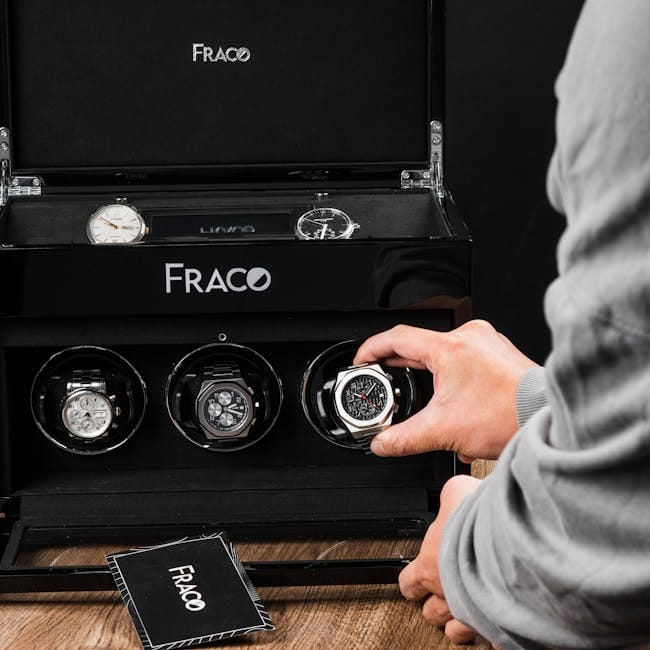
Watch winders have become a standard accessory purchase for new collectors. Luxury watch influencers recommend them. Watch YouTube channels review them. Retailers bundle them with purchases. The implicit assumption: if you own automatic mechanical watches, you need winders to maintain them. This assumption is wrong for roughly 80% of automatic watch owners, and the winder industry benefits from the confusion.
I own three automatic watches and no winders. I've discussed winder utility with 40+ collectors over the past decade. The specific cases where winders genuinely help are narrow and specific; the majority of automatic watch ownership scenarios don't benefit from winders and may actually accelerate wear on movements that would otherwise rest unwound between wear cycles. Understanding when winders actually help requires examining the specific mechanical and ownership factors involved.
When Winders Actually Help
Scenario 1: You own a perpetual calendar watch and wear it less than 4 days per week. Perpetual calendar complications track year, month, date, and sometimes moon phase through mechanical counters. If the watch stops because of inadequate winding, resetting the full calendar requires specific procedure (often with a Patek or Lange, this means careful manipulation of multiple correctors, and for some references the setting procedure requires watchmaker intervention if done incorrectly). For perpetual calendars worn intermittently, a winder prevents the setting inconvenience.
Scenario 2: You own multiple GMT or world-time complications for travel purposes. If you wear one on each trip and rotate through several, a winder keeps each watch set to its designated time zone (home vs travel) without requiring re-setting each time you switch watches. This is specifically useful for frequent international travelers who maintain watches calibrated to multiple time zones.
Scenario 3: You own a watch with moon phase or annual calendar complication and want to maintain the displays without requiring periodic resetting. Same logic as perpetual calendar — the setting procedure is complex enough that keeping the watch wound is more convenient than periodic resetting.
Scenario 4: You own a watch with power reserve display and want to observe the automatic winding dynamics specifically. This is a marginal case — you could simply wear the watch to wind it — but some collectors specifically enjoy watching the winding dynamics through the power reserve indicator.
- Legitimate winder use: perpetual calendar with intermittent wear
- Legitimate winder use: GMT/world-time rotation for frequent travelers
- Legitimate winder use: moon phase or annual calendar with intermittent wear
- Unclear benefit: standard automatic watches with time-and-date only
When Winders Don't Help
Scenario 1: You own a standard automatic watch (Rolex Datejust, Omega Seamaster, Submariner, etc.) and wear it regularly. The watch winds itself during wear. When you take it off for the weekend, the 48-72 hour power reserve is sufficient to keep it running until you wear it again. If it stops, setting the time and date takes 30 seconds. A winder adds no meaningful convenience to this ownership scenario.
Scenario 2: You own a single automatic watch and wear it daily. The watch winds continuously during daily wear and doesn't need supplementary winding. A winder is pure accessory purchase with no functional benefit.
Scenario 3: You own multiple automatic watches and rotate through them. When each watch is off your wrist for 2-7 days, the power reserve keeps it running for most of that period, or the watch simply stops and requires 30 seconds of setting when you pick it up again. Rotation schedules longer than the power reserve mean you'll reset watches occasionally — but a winder for every watch you own creates substantial desk/safe space consumption for marginal benefit.
Scenario 4: You own mechanical watches but don't specifically care about watch collecting as hobby. You want to own watches, use them, and not think about them. Winders add complexity and maintenance requirements (the winder itself needs power, occasional cleaning, and replacement belts or gaskets) that don't improve the underlying watch ownership experience.
The Specific Mechanical Concerns
Continuous automatic winding on a watch kept in a winder 24/7 has specific implications for movement wear. The rotor bearings experience continuous operation rather than the intermittent use during daily wear. Over 20+ years of continuous winding, rotor bearing wear can accumulate in ways that wouldn't occur with normal wear-and-rest cycles.
Winder rotation direction matters. Most automatic movements wind bidirectionally, but some (particularly older or specific manufacture calibres) wind only in one direction. A winder spinning the wrong direction wears components without providing winding benefit. Before using a winder, verify your specific watch's rotor winding configuration — bidirectional, clockwise only, or counterclockwise only.
Rotation cycles vary across winders. Higher-end winders use programmable cycles (turns per day, rest periods between rotation cycles) to provide adequate winding without continuous operation. Lower-end winders spin continuously, which provides excess winding and accelerated component wear. For automatic watches with 50,000+ turn-per-day specifications, continuous rotation exceeds the watch's winding requirements significantly.
Some mechanical specialists argue that continuous winder use can affect mainspring tension dynamics in ways that differ from wear-based winding. The argument: wrist-based winding creates specific tension profiles as the rotor accelerates and decelerates with wrist motion, while continuous rotation creates uniform tension that may subtly affect movement timing over decades. This is a technical concern that affects long-term collector pieces more than daily-wear watches.
When Winders Make Ownership Worse
High-quality winder purchases run $400-$1,500+ per watch unit. Winders for multiple watches (4-watch, 6-watch, 12-watch configurations) can cost $2,000-$6,000. For a collection of 4-8 automatic watches, full winder coverage represents a substantial investment that could instead go toward an additional watch, service reserve fund, or other collection priorities.
Space consumption for winders matters for collectors who keep watches in home offices or in dresser drawers rather than dedicated watch rooms. A 6-watch winder takes 18-24 inches of shelf space and requires power source. This may conflict with other aesthetic priorities in home environments.
Noise from some winders is noticeable. Lower-cost winders use less refined motors that produce audible whirring during operation. In a bedroom or office context, this can become a persistent noise source that affects quality of the space. High-end winders (Wolf Designs, Orbita, Buben & Zorweg) have quieter operation but at price points above $1,000+.
The Value-Oriented Approach
For most automatic watch owners, the correct approach is: no winder. Wear the watch regularly. When it's off your wrist, let it stop. When you pick it up to wear, reset time and date. This takes 30 seconds and produces identical functional outcomes to winder ownership at zero cost.
For collectors with 5+ automatic watches and rotation schedules that exceed typical power reserves, a targeted winder purchase can help. Specifically: buy a single high-quality winder (Wolf Designs Module 4.1 Men's at $500, or Orbita 4-watch at $850) and use it for the specific watches that benefit — the perpetual calendars, GMT references, or watches set to specific time zones. Leave standard automatic watches unwound between wear cycles.
For serious collectors with 15+ watches, a quality multi-position winder becomes useful for inventory management. In these cases, look at high-end options from Buben & Zorweg, Döttling, or custom winder cabinets that integrate with overall collection storage. Budget $2,500-$8,000+ for quality multi-watch winders that combine storage, display, and winding functionality.
The common mistake: buying winders because collecting culture suggests you should, without specific analysis of whether your watches actually benefit from them. The winder industry benefits from this assumption pattern and markets accordingly. Before buying any winder, ask yourself: would this watch actually function better in my specific ownership pattern with continuous winding than with the standard take-off-and-reset cycle?
For 80% of automatic watch owners, the honest answer is no. For 20% of owners with specific complications or rotation patterns, the answer is yes. Figure out which category you're in before spending $400-$2,000 on accessories that may provide no actual ownership benefit. This is one of the areas where watch collecting discourse consistently points buyers toward unnecessary expenditures, and pushing back against the default assumption saves money that's better deployed elsewhere in the collecting pursuit.