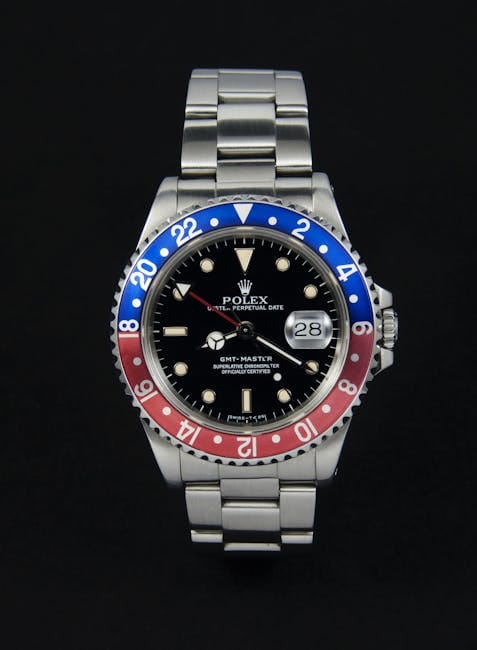
The Rolex Sky-Dweller reference 326934 retails for $15,950 in April 2026. For that price, you get a watch that combines GMT second time zone display with an automatic annual calendar — a complication combination that requires manufacturing expertise specifically, and that no direct competitor offers at this price. Rolex introduced the Sky-Dweller in 2012 and has refined it across multiple iterations, and in 2026 it represents arguably the most functionally capable Rolex in the catalog for the specific use case it was designed around.
I've worn a Sky-Dweller since 2019 — reference 326934 in stainless steel with silver dial. It's the watch I wear during international business travel because the specific combination of dual time zone tracking and calendar automation genuinely makes travel easier. The Submariner and GMT-Master II are arguably cooler watches. The Datejust is arguably more versatile. But for the specific context of international business travel across multiple time zones with meeting schedules in different calendar regions, the Sky-Dweller delivers functional advantages that the more popular references don't. Understanding why requires examining what the complication actually does in practice.
What the Sky-Dweller Does
Two primary complications combined. The GMT function displays a second time zone via the rotating 24-hour disc around the outer dial. The main hour hand shows local time (where you are), while the disc shows a second time zone (typically home time). Reading the second zone: look where the disc numeral aligns with the 12 o'clock position on the dial. The annual calendar function automatically tracks month lengths — 28/29 February, 30 April/June/September/November, 31 all others — and advances appropriately at month-end transitions. You set the calendar once at year-start and, unless we're leaving the Gregorian calendar's annual cycle, the calendar runs accurately throughout the year without intervention.
The practical ownership benefit: during international travel, you set the local time with the crown while the home time remains displayed on the GMT disc. No need to manually track "what time is it at home" during the trip — just look at the watch. Meanwhile, the calendar continues tracking accurately without manual adjustment for month-end transitions that simpler date complications require.
Specific mechanism: the calibre 9001 movement uses Ring Command bezel technology that Rolex developed specifically for the Sky-Dweller. The bezel rotates in three positions, each selecting a different setting function when the crown is pulled — date setting in one bezel position, time setting in another, and month setting in the third. This interface allows complex setting of multiple calendar functions through a single crown/bezel combination, which was genuinely clever engineering.
- Case 42mm × 14.1mm, Oystersteel or multi-metal combinations
- Calibre 9001 automatic with GMT and annual calendar
- 70-hour power reserve
- Ring Command bezel for complex function setting
The movement architecture is substantially more complex than standard Rolex calibres. Calibre 9001 has 380 components (compared to 203 components in calibre 3135 or 290 components in calibre 3186 GMT). The added complexity enables the annual calendar functionality that simpler movements can't support. This engineering investment explains part of the retail pricing premium for the Sky-Dweller.
The Business Travel Use Case
Specific scenarios where the Sky-Dweller delivers functional advantage. Scenario 1: you're flying from New York to Singapore for a week of meetings. You land Tuesday morning local time. You set the watch to local time. The watch automatically continues showing home time (New York) via the GMT disc, so you can quickly reference "it's 8 PM Monday in New York" without mental calculation. When you leave Friday local time, you reset local time back to New York during the flight. The home time was continuously accurate throughout.
Scenario 2: you're splitting weeks between London and Dubai during a specific project. Every Sunday you fly between the two cities. The Sky-Dweller's bidirectional GMT function makes this trivial — adjust local time when you land, reference home/office time through the GMT display, and the watch accurately reflects both time zones continuously. Simpler watches require separate mental tracking of the time zone you're not currently in.
Scenario 3: you travel frequently across dates where months transition. Most automatic watches have date complications that display "31" into February or "30" into March, requiring manual adjustment at month-end. The Sky-Dweller's annual calendar automatically advances the date past 28/29/30/31-day month-ends correctly. For business travelers who don't have time to manage these transitions manually, the automation reduces daily management overhead.
For stationary single-location users, these functional benefits are marginal. A Submariner, GMT-Master II, or Datejust serves the non-traveling professional adequately. But for specific business travel use cases, the Sky-Dweller's combination of dual time zone and annual calendar provides measurable daily management reduction that simpler watches can't match.
Case and Finish
The Sky-Dweller's 42mm × 14.1mm case is larger than most current Rolex sports references. It's bigger than the Submariner (41mm), bigger than the GMT-Master II (40mm), matching the Explorer II (42mm) in overall dimensions. On a 7-inch wrist, the Sky-Dweller sits substantial but not overwhelming. On a 7.5+ inch wrist, it fits perfectly. On smaller wrists (6.5 inch or less), it may read as too large — try one before assuming it fits your wrist size.
Case finishing alternates brushed and polished surfaces. The fluted bezel (on most Sky-Dweller references) is polished 18k white gold on steel-case variants, which creates visual interest and positions the watch as dressier than pure tool Rolex references. The Sky-Dweller reads as "business dress" rather than "sports" or "casual dress" — appropriate for boardrooms, business dinners, and professional contexts where dress-adjacent but not formal-dress watches work.
Bracelet options: Oyster bracelet (standard sports Rolex three-link) or leather strap (reference 326935 options with alligator strap and white gold case). Jubilee bracelet is also available on some references. The Oyster bracelet is the most versatile choice — it works across business contexts and allows the watch to transition to casual wear without feeling overdressed.
Material options beyond stainless steel: white gold, rose gold, or two-tone (steel with gold bezel and hardware). The gold variants are substantially more expensive (starting around $48K retail) and position the Sky-Dweller more toward formal dress rather than business travel tool. For the specific business travel use case, steel is the correct material choice.
Why Collectors Miss It
The Sky-Dweller's lack of cultural recognition creates the primary gap in collector awareness. Unlike the Submariner, Daytona, or GMT-Master, the Sky-Dweller doesn't appear prominently in movies, advertising, or watch media cultural references. New collectors encountering Rolex for the first time typically don't consider the Sky-Dweller because they haven't seen it culturally positioned.
The complication complexity also creates buyer hesitation. Setting the Sky-Dweller's multiple functions requires specific understanding of the Ring Command bezel interface. The 15-minute learning curve discourages some buyers who prefer simpler watches. Once learned, setting is trivial, but the initial complexity is a genuine barrier.
The 42mm size discourages buyers accustomed to smaller modern sports watch sizing. Current collector preferences trend toward 38-40mm cases, and the Sky-Dweller's 42mm reads as oversized in that context. For buyers who like the size, it's perfect. For buyers who prefer smaller cases, it's wrong regardless of functional benefits.
The price positioning creates another consideration. At $15,950 retail, the Sky-Dweller is more expensive than a Submariner or GMT-Master II. For buyers with fixed budgets who need to choose among Rolex sports references, the simpler watches at lower prices often win out based purely on purchase economics rather than specific functional fit.
Availability at Authorized Dealers
The Sky-Dweller is substantially more available at authorized dealers than the Submariner or GMT-Master II. Waitlists typically 6-18 months (vs 24-60+ months for hot sports references). Some dealers carry Sky-Dwellers on display for walk-in purchase. This availability is a specific advantage for collectors willing to buy the watch at retail — you can actually complete the transaction rather than waiting years for allocation.
Grey market pricing is also more rational on the Sky-Dweller. Current grey market premium is 15-30% over retail (significantly less than the 70-130% premium on hot sports references). If immediate acquisition is needed and you don't have an AD relationship, grey market is a legitimate path without paying catastrophic premium.
Secondary market pricing for used Sky-Dwellers: 2020-2022 examples run $15-18K (roughly at or slightly above current retail). Earlier examples (2012-2018 with previous calibre 9001 iterations) run $12-15K. The depreciation is minimal, reflecting steady demand and relatively modest new production volumes.
Comparing to Alternatives
Within Rolex's own catalog, the GMT-Master II ($11,100 retail) offers GMT functionality without annual calendar at lower price. If you don't need the annual calendar automation, the GMT-Master II is cheaper and potentially better for pure time zone tracking use cases. The Sky-Dweller's premium reflects the annual calendar functionality that GMT-Master II doesn't include.
Outside Rolex, the comparable complication combinations exist from: IWC Pilot's Watch Annual Calendar ($13-18K retail), Zenith El Primero Chronomaster (various configurations with GMT), and Vacheron Traditionnelle Overseas World Time ($35-48K retail). The IWC is legitimately competitive at lower price, offering annual calendar and GMT at more accessible price point. Zenith offers different complication combinations. Vacheron offers haute horlogerie finishing at substantially higher price.
Among these options, the Sky-Dweller positions itself specifically between IWC's accessible pricing and Vacheron's premium pricing. For buyers specifically wanting Rolex quality and brand positioning in the travel watch category, it's the right answer. For buyers willing to look beyond Rolex, the IWC offers comparable functionality at meaningfully lower cost.
The Cartier Pasha de Cartier ($12-15K retail) is sometimes considered alongside the Sky-Dweller as a business dress-adjacent watch with some complication. However, the Pasha doesn't offer GMT functionality, which is the specific reason to choose the Sky-Dweller over simpler alternatives. If you don't need GMT, the Pasha is a different conversation.
Ownership Economics
Service intervals on the calibre 9001 movement are 10 years (consistent with current Rolex specifications). Service cost runs $1,100-$1,600 depending on specific work required. The service is more expensive than standard calibre 3235 service, reflecting the more complex complication mechanism. Rolex Service Center turnaround is 10-16 weeks typically — slightly longer than simpler Rolex references due to calendar mechanism complexity.
Across 20 years of ownership, expect 2-3 service cycles at $1,100-$1,600 each = $2,200-$4,800 total service cost. Annual carrying cost including insurance (typically $180-$280 annually for a $16K watch on specialist coverage) and amortized service cost = $450-$650 annually. This is the honest ownership cost of a Sky-Dweller over extended ownership.
For business travelers who genuinely benefit from the functionality, this cost is reasonable. For buyers whose travel patterns don't match the Sky-Dweller's use case, simpler Rolex references provide equivalent ownership experience at lower annual cost. Self-assessing whether your actual travel patterns justify the complication premium is the key decision question.
The final observation: the Sky-Dweller is the Rolex you should buy if you're a genuine international business traveler, want Rolex quality and branding, and specifically value the GMT plus annual calendar functionality. It's not the right choice for buyers whose primary desire is Rolex ownership for status or investment reasons — other references serve those goals better. For the specific use case it was designed for, the Sky-Dweller delivers genuine functional advantages that few competitors match. That's the right reason to own it, and it's the right reason this underappreciated reference deserves consideration by collectors whose lives genuinely align with its functional capabilities.