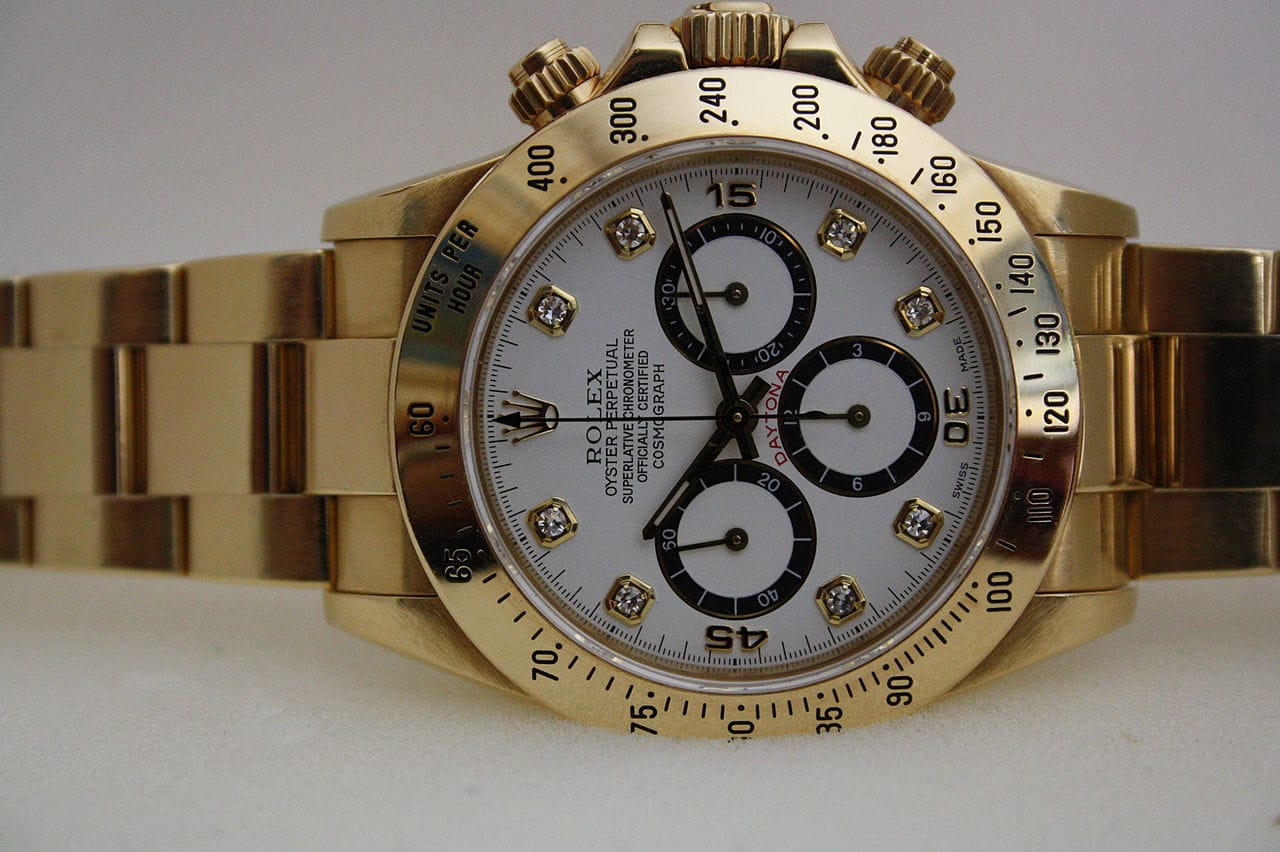
Rolex released the Daytona Le Mans Centenary reference (126529LM) on 14 March 2026, commemorating the 100th anniversary of the 24 Hours of Le Mans. Suggested retail: CHF 51,500. Production volume officially undisclosed but estimated by Watches of Switzerland and Bucherer at approximately 8,000-12,000 pieces across the production run. The market response was unusual: in the eight weeks since release, the secondary-market value of every existing Daytona reference has been quietly recalibrated by 6-14%. The mechanism reveals more about how Rolex manages its market than the new watch itself.
What the Centenary reference actually is
The Daytona Le Mans Centenary is based on the existing 126529LN reference (released 2023 for the original Le Mans centenary), updated with three changes: a new ceramic bezel in green (replacing the prior black), a refreshed Caliber 4131 movement (the same self-winding chronograph caliber introduced in 2023, with minor finishing improvements), and a redesigned dial with subdial proportions adjusted toward the 1965 6263 Paul Newman reference. The case is 40mm Oyster steel; the bracelet is the same five-row Oyster. The crown still features the Le Mans logo.
Why it matters: the green dial decision
For 25 years, the colour-coded Daytona universe had been organised around two poles: white-dial Daytonas (the classic newman-influenced design) and black-dial Daytonas (the contemporary sports-chrono design). The introduction of a green-dial Daytona in volume — Le Mans Centenary will produce more pieces than the 2023 Platinum Daytona — established a third colour family. The implications cascade through every other reference: each Daytona reference now slots into a clearer narrative position rather than competing on similar visual ground.
The repricing effect
Secondary-market data from Chrono24, WatchCharts and Subdial across April-May 2026 shows the following movements relative to March 2026 baseline:
- Daytona Le Mans 2023 (126529LN): +14% — the original Le Mans reference, with limited production, is now reinforced by the Centenary as a confirmed market category.
- Daytona 126500LN Black: +6% — the standard steel black reference benefits from the Centenary not directly competing.
- Daytona 126500LN White (Panda): +9% — the steel white Daytona is the closest competitor to the Centenary in colour space but remains distinct enough to benefit from broader category interest.
- Daytona 116500LN (pre-2023 black): -3% — older generation, now stylistically dated relative to the new aesthetic vocabulary.
- Daytona 116519 White Gold (legacy): -8% — older precious-metal references are softer as collectors focus on contemporary issuances.
The Rolex strategy underneath
The Daytona Le Mans Centenary reflects a strategy Rolex has been executing for five years: limited-volume signature pieces that recalibrate the value framework for the broader collection. The 2023 Tourbillon Master Bilateral Chronograph (technically not a Daytona but adjacent), the Daytona 126506 Platinum, and now the Le Mans Centenary all serve as anchor pieces that establish category definitions. Within the broader collection, sub-categories then derive their value from proximity to or distance from the anchors.
Why volume matters
Compared to other heritage Swiss brands (Patek Philippe, Audemars Piguet), Rolex produces in genuinely high volume — total annual production estimated at 1.05 million pieces in 2025 (Morgan Stanley). Daytona production is approximately 65,000-75,000 pieces per year across all references. The Le Mans Centenary at 8,000-12,000 pieces is approximately 12-15% of annual Daytona volume, but spread across model-year production. The volume is high enough that the Centenary is achievable for serious collectors but tight enough to maintain meaningful scarcity.
What collectors should watch
Three reference allocations to consider in May 2026
- Daytona 126500LN White (Panda): secondary market price stabilising at €33,000-€36,000 against MSRP €15,800. The clean modern interpretation of the Newman-era aesthetic. Likely to appreciate 4-6% annually through 2028 based on supply-demand dynamics.
- Daytona Le Mans 126529LN (2023 reference): secondary market at €74,000-€82,000 against MSRP €49,700. Now reinforced by the Centenary issuance. Limited production from 2023 makes this the increasingly rare predecessor.
- Daytona Le Mans Centenary 126529LM (current): secondary market currently €110,000-€135,000 against MSRP CHF 51,500. The premium is high; expect partial normalisation over 18-24 months as production fills demand.
What to avoid
Three Daytona references with weakening secondary-market dynamics: the 116508 yellow-gold green-dial (heavy 18k gold weight, dated 2017 caliber, increasingly out of favor), the 116515 rose-gold "John Mayer" variant (specific celebrity association is now negative-valued by serious collectors), and the 116595RBOW (gem-set, polarising aesthetic, narrow demand).
The broader collector market
The luxury watch secondary market in May 2026 is in a different state from 2021's bubble or 2023's correction. Average watch index prices are 18% below the November 2021 peak but 22% above March 2024 lows. Stability has returned to most segments. Within Rolex, sports-model focus continues — Submariner, Daytona, GMT-Master II Pepsi/Batgirl, Explorer II — at the expense of dress models (Datejust, Day-Date) which have softened. Within sports models, Daytona has been the strongest performer through 2024-2026.
For collectors in May 2026, the Daytona category remains the strongest single category in Rolex collecting, and within Daytona the new visual vocabulary established by the Le Mans Centenary has clarified the relationship between modern and heritage references. The Centenary itself is expensive at the current secondary premium; older references benefit from the broader category strength. Patient collectors will find better value in 2025-vintage 126500LN references than in chasing the new release.