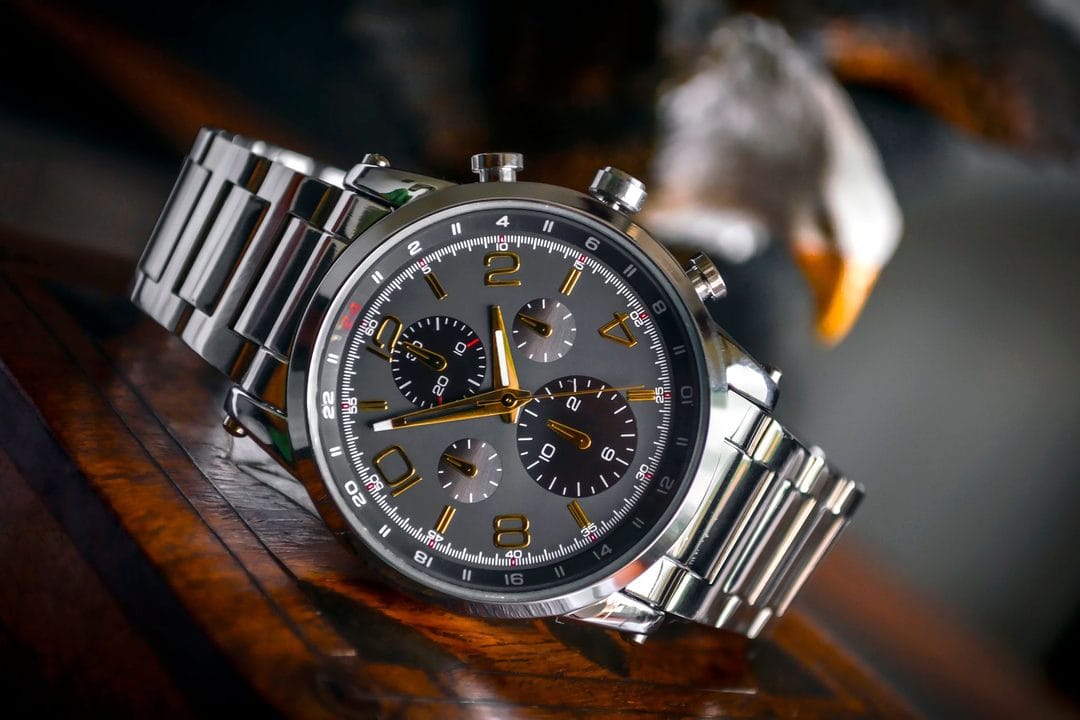
Ask ten collectors what the first proper mechanical watch should be and you will get ten answers, most of them defensive about whatever they happened to buy first. But there is a genuinely good answer, and it has been hiding in plain sight on the wrist of every astronaut since 1965. The manual-wind chronograph — and specifically the Omega Speedmaster Professional, the Moonwatch — is the most quietly sensible serious watch a person can own, and the reasons have almost nothing to do with the space programme.
Why a manual-wind chronograph at all
A chronograph is a watch with a built-in stopwatch — pushers on the side start, stop, and reset a sweeping seconds hand and a couple of sub-dials. Most modern ones are automatic, winding themselves from the motion of your arm. The Speedmaster Professional, almost alone among famous watches, is still hand-wound, and that is the whole point rather than a quaint inconvenience. Winding a watch every morning is a thirty-second ritual that connects you to the object in a way an automatic never quite manages. You feel the mainspring tension up under your thumb. The watch is, briefly, something you do rather than something you merely wear.
There is a mechanical honesty to it too. The Calibre 3861 movement inside the current Moonwatch is a co-axial, Master Chronometer-certified evolution of the legendary 321 and 861 that came before it, and Omega will service it more or less forever. A hand-wound chronograph movement is also simply lovely to look at, which is why the current model comes with a sapphire caseback option — you can watch the thing run. None of this is essential. All of it is the reason people keep the watch for forty years.
The price reality, stated plainly
Let us not pretend it is cheap. The current Moonwatch Professional on the bracelet sits at roughly £6,400 at retail in the UK, with the Hesalite-crystal version a few hundred less than the sapphire-sandwich one. That is real money. But it is also, by the standards of Swiss watches that carry this much history and this level of finishing, almost suspiciously fair. A comparable in-house manual chronograph from most of Omega's rivals starts well north of ten thousand, and the genuine icons — a Patek or a Lange chronograph — are an order of magnitude beyond that. The Speedmaster delivers the substance of a grail watch at a price a normal person can, with planning, actually reach.
Hesalite or sapphire — the one real decision
When you buy a Moonwatch you face exactly one meaningful choice, and collectors will argue it until closing time.
- The Hesalite version uses a domed acrylic crystal — the same plastic that flew to the Moon, because glass could shatter in a depressurised cabin. It scratches easily, but scratches polish out in two minutes with a tube of Polywatch and your thumb, and the warm distortion across the dial is the single most charming thing about the watch. This is the purist's choice and the historically correct one.
- The sapphire version swaps in a scratch-resistant sapphire crystal front and back, lets you see the movement, and costs a little more. It is the modern, practical, slightly less romantic option. Plenty of very serious collectors own this one and never look back.
- If you cannot decide, buy the Hesalite. It is the one the watch was meant to be, it is cheaper, and the acrylic crystal is part of the story rather than a compromise.
That is genuinely the extent of the agonising. Everything else about the watch was settled decades ago and has barely changed, which is exactly why it has aged so well.
What it is not
This is not a do-everything watch, and pretending otherwise sets you up for disappointment. It is only water-resistant to 50 metres, so it is a poor swimmer and a hopeless diver — if you want a beater for the sea, this is the wrong tool and a Seiko or a proper dive watch is the right one. The Hesalite crystal will pick up hairlines from a careless brush against a doorframe. And manual winding means that if you take it off for two days, it stops, and you reset it. None of these are flaws so much as a character: the Speedmaster asks for a small amount of attention and rewards it. A watch that demands nothing of you tends to give nothing back.
The case for buying it first, not last
Most people work up to a Speedmaster after a string of cheaper watches they eventually grow out of and quietly sell at a loss. That is the expensive route. Buy the Moonwatch early and you skip the churn entirely, because there is nowhere to grow out of — it is already the destination. It is dressy enough under a cuff, robust enough for daily wear, historically unimpeachable, and supported by a service network that will keep it ticking long after you have stopped caring about whatever the watch press is hyping this year. Spend the money once, learn to wind it every morning, and you are done. There are worse things to be finished thinking about.