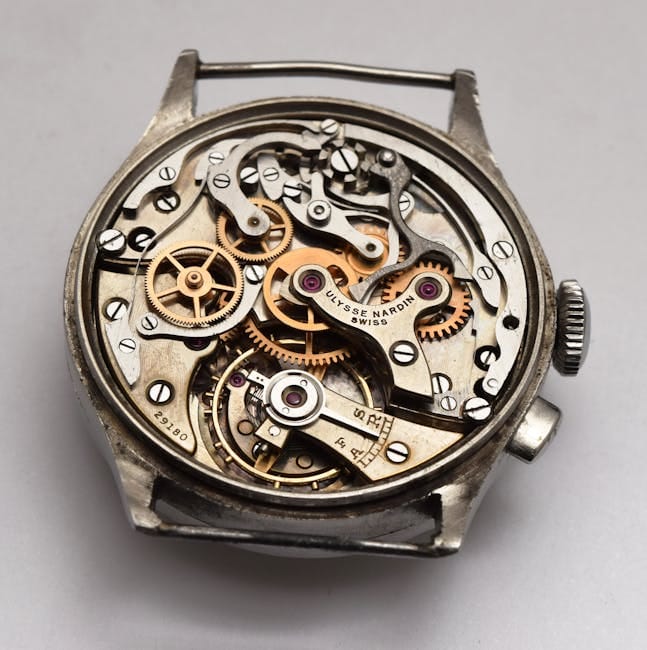
Two Swiss chronograph calibres defined 20th-century watchmaking more than any others. The Lemania 2310 (produced 1942-1989) powered most of the significant Swiss chronographs of its era — Omega Speedmasters (in modified form as calibre 321), Patek Philippe chronographs, Vacheron Constantin references, Roger Dubuis early pieces, and specific Audemars Piguet chronographs. The Valjoux 72 (produced 1938-1974) powered the vintage Rolex Daytona references, Heuer Carrera and Autavia chronographs, the Breitling 806 Navitimer, and most significant mid-tier Swiss chronographs of the period. Together, these two movements formed the backbone of mechanical chronograph watchmaking for roughly five decades.
Understanding these movements matters for vintage watch collectors because they're still found in references that trade on secondary markets in 2026, because their mechanical characteristics differ in specific ways that affect ownership experience, and because authentication and service considerations vary meaningfully between the two calibres. I've examined dozens of examples of both movements over the past decade, had multiple serviced by specialists, and can offer a practical comparison that watch collector resources often don't articulate clearly.
The Lemania 2310 Architecture
The Lemania 2310 is a manual-wind chronograph calibre, 27mm diameter, 6.5mm thickness, column-wheel controlled chronograph with horizontal clutch engagement. Technical specifications: 18,000 bph (later versions 21,600 bph), 40-hour power reserve, 17 jewels, 270 components total. The movement architecture uses a column wheel positioned at the 4 o'clock region, operated by lever systems connected to the chronograph pushers through specific geometric linkages.
The Lemania 2310 is considered the more refined of the two calibres by vintage chronograph specialists. The movement's finishing potential is higher — when Patek Philippe used it in their chronographs (as calibre 27-70), the finishing quality was at haute horlogerie standard with hand-polished bevels, Geneva stripes, and specific component decoration. The Lemania 2310's core architecture supported this level of finishing in ways the Valjoux 72 didn't — specifically because the bridge geometry and component layout allowed for more hand-finishing real estate.
Specific Lemania 2310-based references that are significant in vintage collecting: Patek Philippe references 130, 1463, 1579, 2499 (all with Lemania-based 27-70 movement); Omega Speedmaster references CK 2915, CK 2998, and 105.012 (all with calibre 321, which is Lemania 2310-based); Vacheron Constantin Cornes de Vache references from the 1950s; Jaeger-LeCoultre chronographs from the 1950s-1960s.
- Lemania 2310: 27mm diameter, 6.5mm thick, 40-hour reserve
- Column wheel at 4 o'clock position, horizontal clutch
- 18,000 bph (later versions 21,600 bph)
- Higher finishing potential for haute horlogerie applications
The Lemania 2310's specific watchmaking character — the feel of engaging the chronograph, the specific resistance in the pushers, the audible click of the column wheel — is distinctive and preferred by most serious vintage chronograph collectors. Engaging a properly serviced Lemania 2310 chronograph is a tactile experience that the Valjoux 72 can approach but not quite match. This is subjective preference rather than objective superiority, but most specialists agree on the hierarchy.
The Valjoux 72 Architecture
The Valjoux 72 is a manual-wind chronograph calibre, 29.6mm diameter, 6.8mm thickness, column-wheel controlled chronograph with vertical clutch engagement (a significant architectural difference from the Lemania 2310). Technical specifications: 18,000 bph (most production), 45-hour power reserve, 17 jewels, approximately 255 components. The column wheel is positioned at 12 o'clock region with lever linkages to chronograph pushers.
The Valjoux 72 is mechanically robust in specific ways the Lemania 2310 isn't. The vertical clutch engagement produces cleaner chronograph starts and stops — the chronograph hand begins and ends motion more precisely than horizontal clutch engagements typically manage. Over decades of ownership, vertical clutch engagements also show less wear than horizontal clutches, which means Valjoux 72 chronographs tend to maintain their crisp chronograph action longer than Lemania 2310 chronographs do.
Significant Valjoux 72-based references: Rolex Daytona references 6239, 6240, 6241, 6262, 6263, 6264, 6265 (the entire "pre-Zenith" Daytona era); Heuer Carrera references 2447 through various evolution; Heuer Autavia references 2446 through various evolution; Breitling Navitimer 806; Zenith El Primero pre-transition references; Wakmann chronographs.
The Valjoux 72's finishing potential is lower than the Lemania 2310 for specific mechanical reasons. The bridge geometry leaves less area for hand-finishing application, and the component layout requires smaller individual parts that resist elaborate decoration. Valjoux 72 movements in vintage Rolex and Heuer references show functional finishing (perlage, blued screws, basic Geneva stripes) but not haute horlogerie-level decoration. This reflects the Valjoux 72's positioning as a workhorse tier movement rather than a showcase manufacture calibre.
Collector Preferences
Among serious vintage chronograph collectors, the Lemania 2310 and Valjoux 72 fill different preferences. The Lemania 2310 appeals to buyers focused on haute horlogerie, Patek and Vacheron brand tradition, and the specific aesthetic of refined Swiss finishing. The Valjoux 72 appeals to buyers focused on tool chronograph heritage, Rolex and Heuer brand tradition, and the specific aesthetic of functional manufacture.
These preferences aren't mutually exclusive — many serious collectors own both Lemania 2310-based and Valjoux 72-based pieces in their collections, specifically to represent both Swiss chronograph traditions. A collection might include a Patek 2499 (Lemania 27-70), an Omega Speedmaster CK 2998 (Lemania 321), a Rolex Daytona 6263 (Valjoux 72), and a Heuer Carrera 2447 (also Valjoux 72). Each piece represents different aspects of 20th-century chronograph watchmaking.
Pricing patterns reflect these preferences. Lemania 2310-based pieces at comparable condition grades typically command 10-20% premiums over Valjoux 72-based pieces from the same era, specifically reflecting the Lemania's haute horlogerie association and the higher-end brands that deployed it. This premium exists across all vintage chronograph price tiers, from $10K entry references up to $500K+ Patek chronographs.
Authentication Considerations
Authentication challenges are specific to each movement type. Lemania 2310 authentication requires verifying movement serial numbers against case reference production dates, examining bridge architecture for period-correct component configuration, and specifically checking for movement swapping between different brand applications. A Lemania-based movement from an Omega Speedmaster can be physically transplanted into a Patek case with professional work — and this has happened on specific fraudulent pieces that circulated in secondary markets during the 2010s.
Valjoux 72 authentication has different common failure modes. Service-replacement Valjoux 72 movements from the 1980s-1990s were sometimes installed in earlier reference cases. Movement serial numbers can be re-stamped on specific component positions to match intended case references. The column wheel configuration can be verified by specialists through specific identifying marks, and the pallet fork geometry differs between early production (pre-1960) and later production in ways that should match the piece's claimed production date.
For both calibres, authentication requires specialist expertise. Independent vintage chronograph specialists (Eric Ku, Matt Bain, HQ Milton's watchmakers) can authenticate these movements at standards that general collectors or mainstream dealers can't match. For any purchase of Lemania 2310 or Valjoux 72-equipped piece above $25K, professional authentication is worth the $300-$500 service fee.
Service Considerations
Both movements require specialist service rather than generic watchmaker service. Parts availability for Lemania 2310 and Valjoux 72 is limited — the movements are no longer in production, parts are sourced from dismantled movements or from limited dealer inventory of original components.
Lemania 2310 service typically runs $1,200-$2,200 depending on work required and specialist choice. Specific specialists who work on Lemania 2310 movements: Eric Ku's watchmakers, Wempe's vintage service division, specific Paris and Geneva-based specialists who graduated from major manufacture service departments, and certain dealer-connected service operations in New York.
Valjoux 72 service runs $900-$1,800 at specialist service operations. The Valjoux 72 has broader service availability than the Lemania 2310 because more watchmakers were trained on the movement during its production period. However, the specific vintage expertise required for proper Valjoux 72 service is still specialized — generic Swiss watchmaker training doesn't produce the period-specific knowledge needed for high-quality vintage Valjoux 72 service.
Service intervals for both calibres are 4-6 years on regularly-worn pieces. Unlike modern movements with 7-10 year intervals, these vintage chronograph calibres require more frequent attention to maintain optimal timing and chronograph function. Budget for this as a real cost of ownership — over 20 years of active wear, expect 3-4 service cycles at $1,000-$2,000 each.
Neither movement is more maintenance-intensive than the other. Both are robust designs that reward regular proper service. Both deteriorate if neglected for extended periods. Both can provide another 40-60 years of reliable function if maintained correctly. The mechanical character that defined 20th-century Swiss chronograph watchmaking lives on in these movements for anyone willing to commit to the service cycle ownership requires.