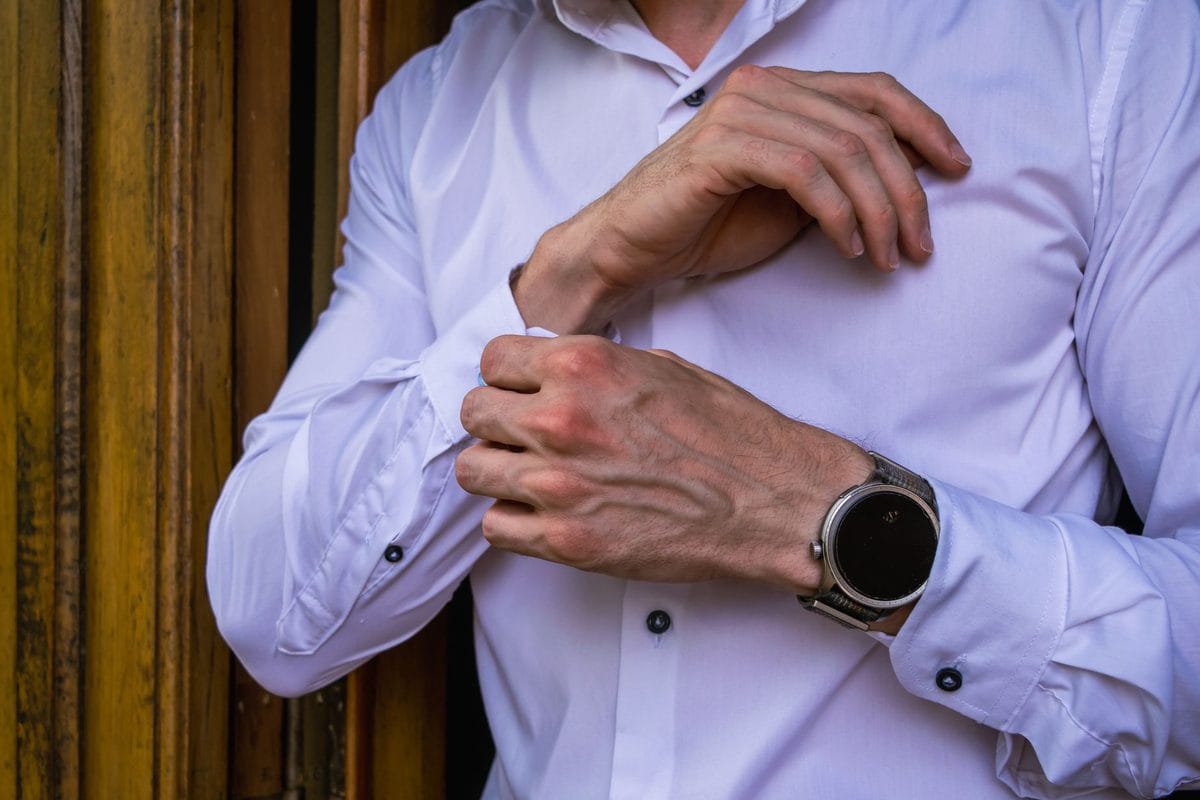
The first properly cold morning of the year is when many owners find out which of their watches was only ever a summer watch. You pull a jacket over a shirt cuff, reach for the train door, and feel the sleeve ride up and stop dead against the case. The watch hasn't changed since August; what changed is the fabric around your wrist, and the one spec that matters now, case height, is the one almost nobody checks before buying.
Diameter Gets Quoted, Height Gets Noticed
Shop for a watch online and the first figure you see is diameter, because it tells you how the thing will look on your wrist from across a table. Lug-to-lug comes second, since it shows whether the case will overhang a narrow wrist. Thickness sits further down the specification list, usually in the same small type as the water resistance, and most buyers never read it until the watch is on their arm and catching on a sleeve. Yet once cuffs are back in your week, height is the dimension that separates a watch that glides under a shirt sleeve from one that sits on top of it like a paperweight. A dress-shirt cuff is cut to be snug at the wrist, which leaves almost no slack above the strap, so every extra millimeter of case has to be absorbed by fabric stretching, and cotton only stretches so far. Treat 10 mm as the working line: below it, a watch slips under a fitted cuff without a fight; between 10 and 12 mm, the shirt decides; at 13 mm and above, plan on wearing the watch over the cuff or saving it for days with softer sleeves. That line is a rule of thumb rather than a standard, and a generously cut barrel cuff will forgive more than a slim one, but it sorts a watch box into three piles faster than an afternoon of trying things on.
The Numbers, Straight From the Brands
Here are seven watches, each measured the only way that matters for this question: the thickness the manufacturer publishes for the exact reference named.
| Watch | Size | Published thickness | Movement |
|---|---|---|---|
| NOMOS Tangente, ref. 101 | 35.0 mm | 6.2 mm | Hand-wound |
| Cartier Tank Must, Large, steel | 33.7 x 25.5 mm | 6.6 mm | Quartz |
| Jaeger-LeCoultre Reverso Classic Monoface Small Seconds | 40.1 x 24.4 mm | 7.56 mm | Hand-wound |
| Patek Philippe Calatrava 6119G-001 | 39 mm | 8.08 mm | Hand-wound |
| Audemars Piguet Royal Oak 15510ST | 41 mm | 10.5 mm | Self-winding |
| Tudor Black Bay 58, steel | 39 mm | 11.7 mm | Self-winding |
| Omega Speedmaster Moonwatch Professional, Hesalite | 42 mm | 13.54 mm | Hand-wound |
Read those figures with a little salt. Tudor's current page lists the Black Bay 58 at 11.7 mm, while reviews written around its debut measured it at 11.9 mm, and Omega's page gives 13.54 mm for the Moonwatch where reviews have quoted anywhere from 13.2 to 13.6 mm across the family. Gaps of a few tenths can come from where the measurement is taken or from small changes between production runs, and they never move a watch from one band to another. What they do mean is that you should read the spec page for your exact reference, and if a brand doesn't publish a height at all, ask the dealer to put calipers on the display piece.
Under 9 mm: Watches That Disappear
The first four rows of that table barely register as objects under a sleeve.
Start with the Cartier Tank Must in the Large size, 33.7 by 25.5 mm and 6.6 mm thick, which Cartier's US site lists at $4,400. It runs on quartz, and for a watch whose entire job is to live under cuffs that is the right call: no rotor, no winding, nothing adding stack height to the case. If your autumn is mostly shirts and jackets and your budget stops well short of Patek, the Tank Must is the better buy than the Calatrava 6119G, which is only about 1.5 mm thicker yet carries a $37,510 list price, more than eight times as much. The Patek is the finer object, with a hand-wound 30-255 PS caliber and a 65-hour power reserve, but a cuff can't tell 6.6 mm from 8.08 mm, and your bank balance can.
If you want a mechanical movement in the same bracket, the NOMOS Tangente is the thinnest watch in the table at 6.2 mm, powered by the in-house DUW 4001 caliber. Jaeger-LeCoultre's Reverso Classic Monoface Small Seconds adds a different advantage: it is 40.1 mm long but only 24.4 mm wide and 7.56 mm high, so the part that has to pass under the cuff is a thin, narrow rectangle. Both are hand-wound, which is part of how they stay that slim.
10 to 12 mm: Where the Shirt Decides
The Audemars Piguet Royal Oak 15510ST measures 41 mm across and 10.5 mm thick on AP's own spec page, which makes it 1.2 mm slimmer than the 39 mm Tudor Black Bay 58 at 11.7 mm. That is the opposite of what you'd guess from the diameters, and it explains why a steel sports watch with an integrated bracelet can be easier to live with in a jacket than a dive-inspired one. Neither is a dress watch, and both land close enough to the 10 mm line that the shirt, not the watch, is the variable. Many dress shirts come with two cuff buttons, and the looser position is the quickest way to learn, in about ten seconds, whether the case clears. Diameter still counts at this thickness, because a longer case means more of the cuff has to ride up and over it, so the slimmer Royal Oak can still be the more awkward of the two under a tight sleeve.
Jaeger-LeCoultre's Reverso Classic Duoface Small Seconds belongs in this band too. It fits two dials into 10.34 mm, a hair under the Royal Oak, though at 47 by 28.3 mm it is a longer case, and length is exactly what the cuff has to ride over.
13 mm and Up: The Speedmaster Problem
The Omega Speedmaster Moonwatch Professional is 42 mm across, 47.50 mm lug to lug and 13.54 mm thick, with a Hesalite crystal and the hand-wound Calibre 3861; Omega's site lists it at $7,800. It is one of the great everyday watches, and it is also the clearest case of a great watch that is wrong for a fitted cuff. Don't force it: a sleeve dragged over a case it was never cut to clear bunches behind the lugs every time you reach for something, and the cuff edge takes the wear. Give the Speedmaster the sleeves it suits instead, such as a ribbed sweater cuff that stretches over the case, a field jacket with a looser opening, or an overshirt with the cuff rolled back twice.
What Autumn Fabrics Change
Thickness figures describe the watch, but autumn changes the fabric, and the fabric is half of the equation. Flannel, tweed and heavy brushed cotton have less give than the poplin and oxford cloth you wore in June, so a cuff that took a 10.5 mm case in summer can refuse it in October. A jacket adds a second sleeve around the same wrist, which means the clearance you tested with the shirt alone shrinks again once the jacket is on. Knitwear works the other way, because a ribbed cuff is made to stretch, and that is why watches over 12 mm that fail every test with a dress shirt tend to look entirely at home over a sweater. The practical test costs nothing: put on the actual shirt and jacket you plan to wear, strap the watch on the way you normally would, drop your arm, then lift it as if reaching for a door handle. If the cuff rides up and lands on the crown rather than past the case, the watch has failed, and no strap swap will fix it, because a strap doesn't change case height. A shirtmaker can sometimes let out a cuff by a few millimeters, which is worth asking about before you buy a thick watch rather than after.
Before the next cold snap, put your thickest watch on, button the loosest cuff you own, and raise your arm. If the sleeve stops at the crown instead of sliding past the case, that watch is a weekend piece until spring.