On 11 September, five days after Geneva Watch Days wrapped for another year, Chopard put out a press release that most watch media treated as a footnote. Two new watches, each limited to 25 numbered pieces, sold only through Chopard boutiques, timed to the 30th anniversary of a manufacture most casual buyers have never heard of. No livestream, no influencer seeding, no queue outside a pop-up. Just a cellist, Gautier Capuçon, touring the workshops in Fleurier and talking about the discipline that turns years of practice into something that looks effortless.
That quiet rollout is the whole story of Chopard’s L.U.C line, and it is exactly why serious collectors keep circling back to it after every hype cycle around Rolex, Patek Philippe and Audemars Piguet burns itself out. The manufacture in Fleurier turned 30 this year. It has spent every one of those years building a case that almost nobody outside the trade bothers to make.
What actually launched on 11 September
Twenty-five pieces each, boutique-only, gone before most collectors even heard the announcement.
The two watches are the L.U.C 1963 Heritage Chronograph and the L.U.C 1963 Heritage Regulator, and they are deliberately built to opposite briefs. The chronograph is the technical showpiece. Inside is the manually wound L.U.C 03.07 L, a fully integrated column-wheel chronograph with a vertical clutch and a flyback function operated through the pusher at 4 o’clock — press it mid-timing and the hands snap back to zero and restart in one motion, no need to stop first. A system of three pivoting hammers with elastic arms handles the reset, and a stop-seconds function lets the small seconds hand zero out when the crown is pulled, which is what lets an owner actually synchronise the watch to the second rather than approximate it.
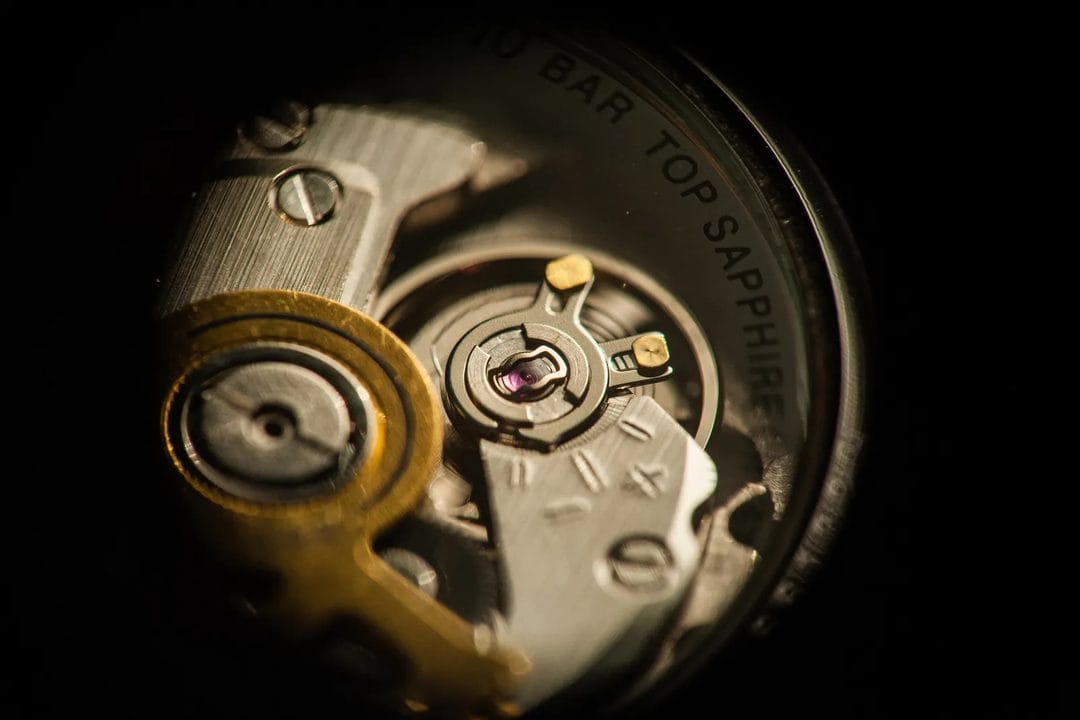
The movement runs at 28,800 vph across 38 jewels and delivers 60 hours of power reserve, finished with circular graining, straight graining and Côtes de Genève, German silver bridges against a gilded mainplate, and bevelled angles sharp enough to catch light through the sapphire case back. It carries the Po¡nçon de Genève, the Geneva Seal, which since its 2012 revision certifies not just decoration but the running accuracy of the finished, cased watch — a meaningfully higher bar than a movement-only stamp. The case is 42mm in Lucent Steel, Chopard’s own recycled-content steel alloy, 11.48mm thick, with a Prussian Blue sunburst dial and no date window, because Chopard’s designers clearly decided legibility mattered more than a feature nobody asked for.
The Regulator is the restrained half of the pair, and the more technically ambitious one underneath. Its L.U.C 98.02 L calibre uses Chopard’s Quattro architecture — four mainspring barrels feeding a single gear train — to produce a 216-hour power reserve. That is nine days on a single wind, from a movement that is only 4.90mm thick. Six separate indications sit on the dial: hours at 3 o’clock, sweeping minutes at the centre, small seconds at 6, a 24-hour GMT display at 9, power reserve at 12, and a date window tucked at 6 without crowding the seconds sub-dial. It is COSC-certified and carries the Geneva Seal, cased in 40mm of 18-carat ethical white gold at just 10.30mm thick. Both watches are numbered out of 25 and will not be restocked once allocated.
The anniversary piece that anyone can actually order
Less exclusive, and arguably more interesting for a first-time L.U.C buyer, is the L.U.C 1860 in Lucent Steel that Chopard showed at Watches and Wonders back in April. It revives the exact 36.5mm × 8.2mm proportions of the original 1996 watch, runs the L.U.C 96.40-L with Chopard’s Twin-barrel architecture and a 65-hour reserve wound by a micro-rotor in 22-carat ethical gold, and carries both COSC certification and the Geneva Seal. It costs €28,200. That is not pocket change, but it undercuts what dealers currently ask over list for an entry steel Royal Oak, and it buys a manufacture calibre with a hand-guillochéd “Areuse Blue” dial made in-house by Metalem, Chopard’s own dial specialist.
Why 1996 matters more than most people realise
Karl-Friedrich Scheufele founded the Fleurier manufacture in 1996, at a moment when the phrase “manufacture calibre” barely registered as a marketing category, let alone a collector obsession. The first movement out of the workshop, the L.U.C 96.01-L, was co-developed with Michel Parmigiani — a name that means considerably more to independent-watchmaking collectors today than it did then. It packed a micro-rotor, a double barrel and a 65-hour reserve into 27.4mm × 3.3mm, and it became the basis for a watch, the original L.U.C 1860, that launched in 1997 and was named Watch of the Year by the Swiss magazine Montres Passion within twelve months. The manufacture did not stop at three-hand watches, either. It kept building through double tourbillons, split-seconds chronographs and finally, in 2017, the L.U.C Full Strike — a minute repeater that transmits sound through sapphire crystal gongs rather than the traditional cased-in gongs, a genuine acoustic improvement, not just a marketing angle. That watch won the Aiguille d’Or, the top prize at the Grand Prix d’Horlogerie de Genève, which is the watch industry’s own jury confirming that Chopard’s in-house watchmaking had crossed from competent to genuinely important. Most buyers walking past the brand’s Happy Diamonds cases in an airport boutique never hear about any of it.
The catch that keeps this a niche conversation
Here is the part Chopard’s marketing will not volunteer: a 25-piece limited edition sold exclusively through boutiques is, in practice, allocated to existing clients with purchase history at the maison. That is the same soft gatekeeping that keeps a steel Rolex Daytona off the shelf, just without the resale frenzy that makes headlines. A collector with no prior relationship to Chopard is not walking into a boutique in October and walking out with the Heritage Regulator. The realistic entry point is the 1860 in Lucent Steel, or one of the earlier L.U.C references — the 1860, the Quattro, the GMT One — on the pre-owned market, where Chopard’s manufacture pieces trade at a fraction of what an equivalent Patek Calatrava or Vacheron Patrimony commands, largely because too few buyers have bothered to look.
That gap is the actual investment thesis, if there is one worth making here. Buy the current L.U.C 1860 Lucent Steel at €28,200 rather than chase the numbered pair from September, and you get COSC certification, the Geneva Seal and a manufacture calibre with real 30-year lineage, at a price that will not move much in either direction for years. Do not buy it expecting the kind of secondary-market appreciation that steel sports watches have delivered from Rolex and Patek — that market dynamic depends on waiting lists Chopard has never bothered to create for this collection, on purpose.
Where L.U.C sits against the brands everyone already talks about
- Against Patek Philippe’s Calatrava line, the L.U.C 1860 offers a comparably dressy three-hand profile with in-house chronometer certification and Geneva Seal finishing, at roughly a third of the entry price.
- Against Vacheron Constantin’s Patrimony, the case proportions and the restraint are similar; the difference is that Chopard still lets a first-time buyer walk in and simply buy one.
- Against the wave of independent watchmakers — F.P. Journe, Voutilainen, the names collectors now chase instead of the big Genevan houses — Chopard’s L.U.C division is the closest thing a heritage maison offers to that same small-batch, in-house ethos, just backed by a marketing budget built for Happy Sport bracelets instead.
None of that makes the Heritage Chronograph or the Heritage Regulator an easy watch to own. Twenty-five pieces, boutique-only, and a brand that has spent three decades apparently uninterested in telling this story loudly enough for it to matter to the resale market. It is, if anything, a case study in what happens when a manufacture builds genuine Haute Horlogerie credentials and then does almost nothing to convert them into hype.
What to actually watch for next
Chopard’s 30th-anniversary programme is not finished. The Fleurier manufacture has form for spacing out anniversary pieces across a full year rather than dumping everything at Watches and Wonders, which means further L.U.C references marking 1996 — likely a second complication beyond the chronograph and the regulator — are a reasonable bet before the year is out. For collectors already holding an early L.U.C 1860 from the late 1990s, that history is quietly becoming the more interesting story than whatever ships next: a three-decade manufacture record with an Aiguille d’Or on the mantelpiece, still trading at prices that assume nobody is paying attention.