Ask ten watch collectors what belongs in a serious rotation and TAG Heuer rarely makes the first five names — Rolex, Omega, and a rotating cast of independents crowd it out of the conversation. That's a mistake, and 2026 is the year it becomes obvious why. TAG Heuer is Formula 1's official timekeeper again, a role it lost to Rolex more than a decade ago and clawed back for the 2025 season, and it's the title partner of the Monaco Grand Prix through 2026. More importantly for anyone actually building a collection, the brand has spent the last two years quietly replacing outsourced movements with its own — the TH20-00 chronograph caliber now runs across the Carrera line, and the new TH80-00 debuted inside the Monaco Evergraph at Watches and Wonders this spring. None of that shows up on a spec sheet the way a Rolex waitlist does, but it changes the math on what you're actually buying when you put down $4,000 to $7,000 on a TAG Heuer instead of chasing an Omega or a steel Rolex sports model that isn't sitting in the case. This is a company that spent a decade being treated as the value alternative to real luxury watchmaking, and it has finally built the in-house engineering to argue otherwise.
A Racing Watchmaker Since Before Racing Had Watches
Édouard Heuer founded the company in 1860 in Saint-Imier, in the Swiss Jura, and by the 1880s he'd already patented an oscillating pinion still used in mechanical chronographs today — a detail collectors bring up more than the brand's marketing department ever does. The Carrera arrived in 1963, named after the Carrera Panamericana, the brutal five-day road race across Mexico that killed more than two dozen drivers and spectators over its five-year run; Jack Heuer designed the watch specifically for racers who needed to read elapsed time at a glance while doing 150 mph on open highway. Six years later, in 1969, TAG Heuer — still just Heuer then — released the Monaco, the first automatic chronograph housed in a waterproof square case, developed in a three-way race against Zenith and a Breitling-Hamilton-Büren consortium to be first with an automatic chronograph movement. Steve McQueen wore one in the 1971 film Le Mans, not as a paid placement but because his racing advisor wore one, and that accident of casting did more for the Monaco's reputation than any ad campaign since. Heuer stayed independent until 1985, when the Piaget/LVMH-linked TAG Group took a controlling stake and added the "TAG" prefix, and the company has operated inside what's now LVMH's watch division since 1999. That corporate history rarely comes up in collector forums, but it explains why TAG Heuer has access to the kind of movement R&D budget that most mid-tier Swiss brands can only dream about.
Official Timekeeper Again, and Not by Accident
Rolex held the Formula 1 timekeeping contract from 2013 to 2024, a stretch long enough that most fans under thirty assumed the two brands were permanently linked. TAG Heuer took the role back for the 2025 season and used it well, building the Monaco Split-Seconds Chronograph F1 around the sport's own start sequence — the dial references the exact call race directors give at the start of every Grand Prix. For 2026 the brand went further and became title partner of the Monaco Grand Prix itself, a sponsorship that puts the TAG Heuer name on one of the races, alongside Le Mans and the Indianapolis 500, that motorsport fans treat as an unofficial triple crown. The watch that came out of it, the Monaco Speed 12, ships in December as a 50-piece limited run priced around $87,000 — not a piece most readers will buy, but a clear signal of where the brand is spending its engineering budget.
The Three References Worth Actually Owning
Skip the Formula 1 quartz line entirely — it's not a serious watch, it's a keychain with delusions.
Carrera Chronograph
The Carrera Chronograph, powered by the in-house TH20-00 movement, runs roughly $5,950 to $6,700 depending on dial and bracelet choice, which puts it dead in the middle of Omega Speedmaster territory and meaningfully below what a steel Rolex Daytona actually trades for once you account for the retail-to-secondary-market gap. Where it wins against the Speedmaster is legibility — the tachymeter scale sits on the bezel rather than crowding the dial, and the column-wheel chronograph action has the same crisp reset click collectors pay a premium for on far more expensive Swiss chronographs.
Monaco Chronograph
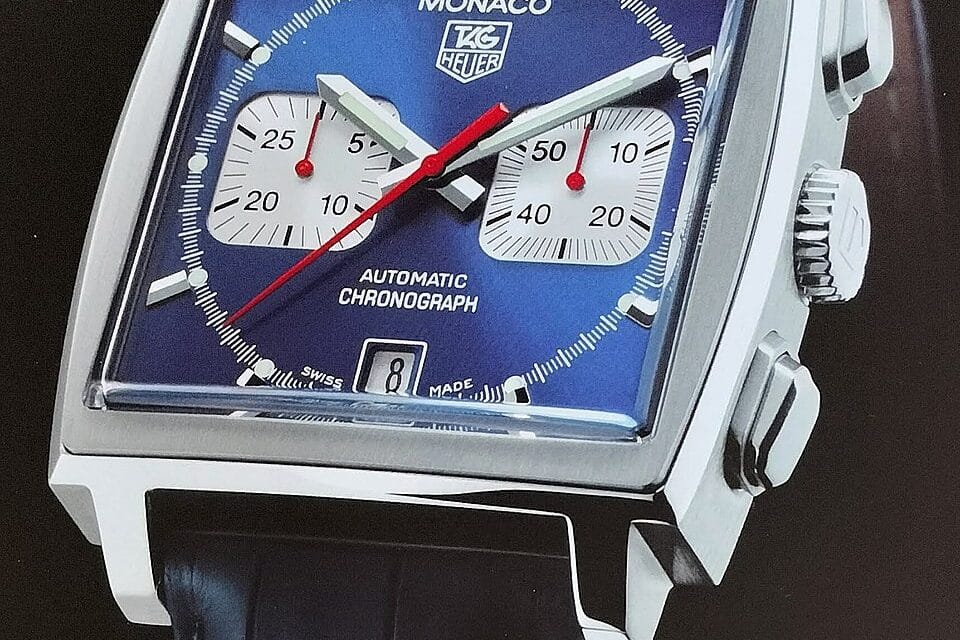
The Monaco Chronograph is the harder sell and the better story: a square case doesn't suit every wrist, and TAG Heuer knows it, which is exactly why the reference keeps getting reissued instead of retired. Expect to pay $6,850 to $7,450 for the current blue-dial reissue, McQueen references included, and understand that you're buying design history as much as a chronograph — nobody else in this price bracket has a 57-year-old case shape with an actual film connection behind it.
Aquaracer Professional
The Aquaracer Professional 200 is the one to buy if you want a single watch that does everything — dive-rated to 200 meters, automatic movement, and priced from roughly $3,500 to $4,200 depending on bracelet, which undercuts a Rolex Submariner's retail price by more than half before you even get to the waitlist problem. It won't hold value the way a steel Rolex sports model does; TAG Heuer resale generally sits well under retail within the first year or two, and buyers chasing appreciation should look elsewhere. But value retention was never really the point of an Aquaracer — wearing it into salt water without worrying about it was.
TAG Heuer Against the Usual Suspects
The honest comparison isn't TAG Heuer versus Rolex — it's TAG Heuer versus Tudor and Breitling, the two brands actually competing for the same $4,000-to-$8,000 shelf space. Tudor's Black Bay Chrono runs a similar price to the Carrera but leans harder into vintage dive-watch styling, which means you're choosing an aesthetic more than a technical difference; both use in-house or in-house-adjacent chronograph movements at this point, and both will hold their value about as well as each other, which is to say modestly. Breitling sits a notch above on price for comparable specs — a Navitimer B01 chronograph starts closer to $8,400 — and trades on aviation heritage the way TAG Heuer trades on motorsport, so the choice there really comes down to whether cockpit instruments or racetrack chronographs speak to you more. None of these three brands will out-appreciate a steel Rolex, and pretending otherwise is how people talk themselves into bad purchases. What TAG Heuer offers that the other two don't, at least right now, is momentum: an actual Formula 1 partnership renewed for multiple years, movement development that's visibly accelerating rather than stalling, and a design language — the Monaco especially — that nobody else in this bracket can borrow.
Where TAG Heuer Actually Fits in a Collection
Buy TAG Heuer for what it does today, not for what it might be worth in five years, and the calculation gets a lot simpler. A first serious watch bought new from an authorized dealer carries a full warranty, and that matters more with an in-house chronograph movement like the TH20-00 than it did with the outsourced Sellita-based calibers TAG Heuer used through most of the 2010s — those older references are the ones worth buying gray market if the price gap justifies the risk, since parts and service knowledge for them are already well established across independent watchmakers. Collectors moving up from a Seiko or Citizen field watch should start with the Carrera; it's the most conventionally proportioned of the three and the easiest to wear five days a week without a second thought. Collectors who already own a Rolex or Omega and want something with actual design conviction, rather than a second version of the same sports-watch formula, should go straight for the Monaco — it reads as a deliberate choice in a way a third steel diver never does. And if the plan is genuinely one watch that survives a decade of ordinary use without babying it, the Aquaracer is the boring, correct answer that nobody ends up regretting.
- Carrera Chronograph — the daily-wear pick, TH20-00 movement, roughly $5,950–$6,700
- Monaco Chronograph — buy it for the case shape and the McQueen connection, not for resale, roughly $6,850–$7,450
- Aquaracer Professional 200 — the one watch that can take a beating and still look right at a desk the next morning, from about $3,500
The gray market discount on last-generation Carreras still running the outsourced Calibre 1887 sits around 15 to 20 percent below current retail on the TH20-00 replacement, which is either a bargain or a warning depending on how much you trust the dealer selling it to you.