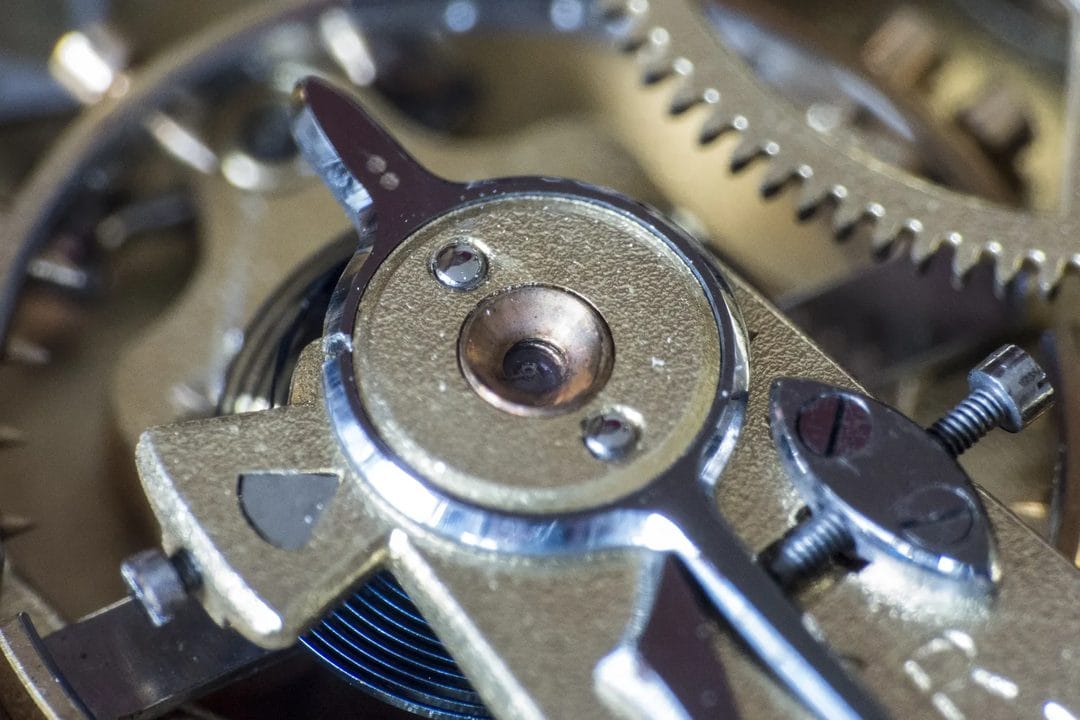
A Rolex service center in Bienne will replace a cracked Syloxi hairspring in about twenty minutes. A watchmaker in a small independent shop with forty years of bench experience, faced with the same cracked spring on a customer's watch, can do nothing but order the part and wait — assuming the part is even available to him at all. That gap, more than anything printed in a boutique brochure, is what silicon has actually done to watchmaking since Ulysse Nardin first put it in a wristwatch in 2001.
Why the industry went looking for a spring that doesn't rust, rot or bend
The traditional hairspring — the coiled sliver of metal that regulates a mechanical watch's timekeeping — has one enemy that no amount of Swiss engineering ever fully solved: magnetism. A conventional Nivarox alloy spring, even the good ones used in a $9,000 Omega or a $40,000 Patek, can pick up a magnetic charge from a laptop speaker, a phone case magnet, or an induction hob and start running fast by anywhere from a few seconds to several minutes a day. Temperature swings do something similar, distorting the spring's geometry just enough to throw off the rate. Watchmakers have known both problems since the 19th century, and for a hundred years the fix was compensation alloys, not a new material.
Silicon changed the calculation entirely. It's non-magnetic by nature, unaffected by humidity, roughly a third the weight of steel, and — because it's etched with the same deep reactive-ion process used to make computer chips — it can be shaped with a geometric precision no lathe or stamping press has ever matched. Ulysse Nardin's early Freak movement in 2001 used silicon and diamond-coated silicon (its patented DIAMonSIL) for the escapement wheel and pallet, largely eliminating the need for lubrication in that part of the movement. Within a decade every major manufacture with the R&D budget to justify a MEMS fabrication partnership had followed, and by 2026 a silicon hairspring or escapement component shows up somewhere in the catalogue of Rolex, Patek Philippe, Omega, Breguet, and a growing list of Richemont brands.
Four brands, four different bets on the same idea
Rolex's version is called Syloxi, launched in 2014 in the Lady-Datejust before spreading into the broader Oyster Perpetual line. Rolex fabricates it in-house at its Bienne facility and claims a rate stability of roughly ±5 seconds a day across a temperature range of −20°C to +60°C, alongside up to ten times the shock resistance of a conventional spring. Patek Philippe took a different route with Spiromax, co-developed with CSEM and Nivarox-FAR and introduced in 2006 inside the annual calendar reference 5205 — its signature is a patented terminal curve etched directly into the silicon, doing mechanically what a Breguet overcoil does on a metal spring, without the manual finishing that overcoil traditionally requires. Omega's Si14 balance spring, rolled out from 2008 across the Co-Axial calibers, came out of the same Nivarox-FAR silicon research that Swatch Group brands share, which is precisely why an Omega 8500 caliber and a Breguet or Blancpain movement from the same era can end up using structurally related silicon components. None of these three approaches are interchangeable, and that's the detail most sales staff gloss over: a Syloxi spring, a Spiromax spring and a Si14 spring look similar under a loupe but come from three separate fabrication lines with three separate spare-parts pipelines. Ulysse Nardin, the pioneer, pushed furthest: the 2014 Ulysse Anchor escapement replaced not just the hairspring but the entire lever-and-wheel escapement with a monobloc silicon flexure spring, a design with no pivots to lubricate and, in principle, almost nothing to wear out under normal use. It's the most radical of the four bets, and also the hardest one to get serviced outside the manufacture itself.
The parts-sharing map that actually matters to a buyer
- Swatch Group brands (Omega, Breguet, Blancpain, and others under the same roof) draw on shared Nivarox-FAR silicon IP, which loosely helps parts continuity within the group over time
- Rolex and Patek Philippe each fabricate their own silicon in-house and do not share tooling, so a Syloxi spring is never a Spiromax spring under a different name
- Ulysse Nardin's monobloc designs are proprietary to specific calibers and, being a single etched piece rather than an assembly of interchangeable parts, are the least modular of the four approaches
- And independents without an in-house MEMS fab — F.P. Journe, MB&F, Voutilainen among them — have mostly stayed with conventional alloys, not out of nostalgia but because the fabrication cost only pencils out at the production volumes of a Rolex or a Swatch Group brand
The catch the boutique won't bring up
A silicon hairspring cannot be repaired.
That's the part that rarely makes it past the marketing copy. A traditional Nivarox spring, if slightly bent or knocked out of true, can often be re-terminated or trued up on a mandrel by a skilled independent watchmaker — it's tedious bench work, but it's work that exists as a craft precisely because the material tolerates it. Silicon doesn't bend back. It's a brittle, etched structure; a crack or a chip means total replacement, no adjustment possible, full stop.
That would be a minor footnote if replacement parts were freely available to any watchmaker with the right tools. They generally aren't. Rolex and Patek Philippe have historically restricted movement components, silicon or otherwise, to their authorized service networks, which is a defensible strategy for quality control and a genuine inconvenience for anyone whose local watchmaker isn't on that list. The American Watchmakers-Clockmakers Institute has flagged parts access as a live concern for independent servicing, not a hypothetical one. A collector buying a 2015 Lady-Datejust with a Syloxi spring today is, whether they realize it or not, also buying a lifetime commitment to a Rolex service center for that specific repair — a trade a Nivarox-spring owner from the 1990s never had to make, since that spring can still be sourced generically or hand-fitted decades later. Independent watchmakers who trained through WOSTEP or similar programs will say the same thing off the record: they can service almost anything mechanical from the last century, but a cracked silicon part from a brand that won't sell them the replacement turns a routine job into a dead end. That's not a hypothetical inconvenience for a $9,000 watch bought to be worn, not vaulted — it's the actual owner experience the day the part fails.
What this actually does to resale value and buying decisions
For the watch you wear daily, silicon is an unambiguous upgrade — better rate stability, meaningfully better resistance to the exact magnetic environment most of us live in now, and one less thing to worry about if you set your watch down near a MagSafe charger. Buy the silicon-equipped reference if daily reliability is the priority; the antimagnetic case-and-movement combination on a modern Omega Aqua Terra or a Rolex Oyster Perpetual genuinely outperforms anything from even fifteen years ago, and there's no reasonable argument for choosing the older, magnetism-prone version instead.
Where it gets more complicated is long-term collectibility, and this is where I'd push back on the assumption that silicon is simply better in every direction. A vintage watch's value is partly built on the fact that a competent watchmaker anywhere in the world can keep it running more or less indefinitely with generic or hand-made parts. Silicon breaks that chain. If Ulysse Nardin ever discontinues fabrication tooling for a specific monobloc escapement — not an unreasonable worry for a company that has changed hands and restructured more than once — owners of that reference are stuck waiting on new-old-stock or a caliber substitution, the same problem quartz-crisis-era orphan calibers created in the 1980s. So the honest answer for someone buying with resale in mind is to treat silicon as a feature you pay for in daily usability and give up a little in long-term parts security, and to weigh that trade specifically against how long you actually plan to keep the watch.
Which references make sense to buy now
A pre-owned Omega Seamaster Aqua Terra with the Si14 spring, typically $2,800–$4,200 on the secondary market for a 2017–2020 example, is close to the sweet spot: Swatch Group's shared silicon program gives it more parts continuity than a boutique-exclusive design, and the antimagnetic case rating (15,000 gauss on some references) solves a real daily problem. A Rolex Oyster Perpetual 36 or 41 with Syloxi, running $6,500–$9,000 pre-owned depending on dial and year, carries the same logic plus the deepest authorized-service network in the industry, which mitigates the parts-lock-in concern more than any other brand can currently match.
Skip a specialty silicon-escapement piece from a smaller manufacture if you're buying purely as a value play — the Ulysse Anchor Tourbillon is a genuinely important piece of engineering history, but it's a monobloc design from a brand whose ownership and R&D funding have shifted before, and that's precisely the profile where parts obsolescence risk is highest. None of this makes the technology a mistake. It makes it a different kind of watch than the one your grandfather could still get serviced at a mall kiosk in 2050, and that's a fact worth knowing before the invoice arrives, not after.