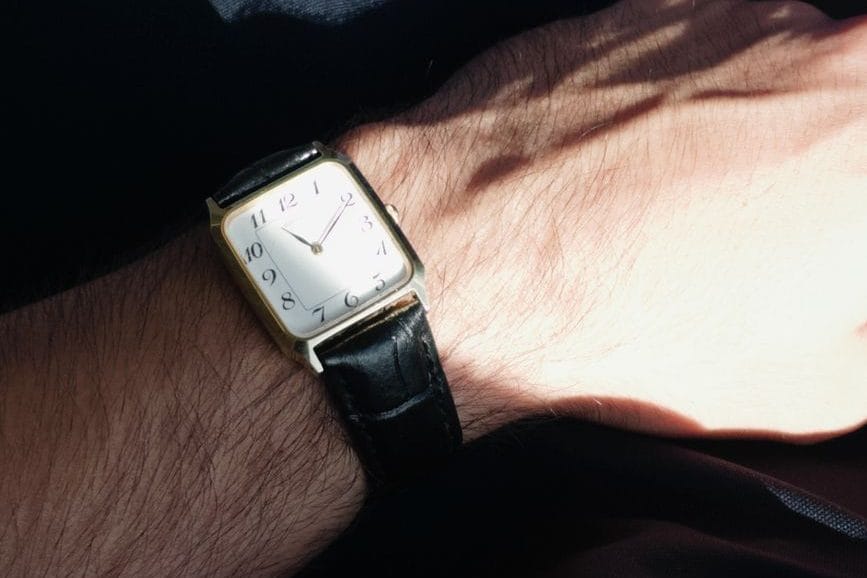
Cartier Gets Filed Under "Jewelry" by People Who Have Never Handled One
Walk into most watch forums and you will eventually hit the same tired line: Cartier makes jewelry that happens to tell time, and Rolex, Omega, and Patek Philippe make watches. It is a lazy distinction, and it falls apart the moment you handle a Santos de Cartier with the in-house 1847 MC caliber or watch a Tank case get hand-finished at the Cartier manufacture in La Chaux-de-Fonds. Cartier has been building its own movements at scale since 2010, holds a genuine place in horological history that predates most Swiss sports-watch brands by decades, and produces two shapes — the Tank and the Santos — that a men's collection is genuinely incomplete without.
This isn't a nostalgia piece. It's a buying guide, and it starts with an unqualified recommendation: if your collection is three round steel sports watches deep and nothing else, your next purchase should not be a fourth one. It should be a Cartier. The Tank and the Santos solve a problem that Rolex and Omega structurally cannot — they wear as dress watches without apologizing for it, and they photograph, and read on the wrist, as design objects rather than instruments.
The Tank: A 1917 Shape That Still Reads as Modern
Louis Cartier designed the Tank in 1917, reportedly inspired by the aerial view of Renault tanks on the Western Front — the brancards (the straight vertical sides) represent the tank's caterpillar tracks, and the rectangular case sits on the wrist unlike almost anything else in the category. General Pershing received one of the first examples. Since then the Tank has appeared on Jacqueline Kennedy, Andy Warhol, Princess Diana, and roughly a century of people who wanted a watch that read as architecture rather than sport. That's the actual pitch: no other case shape in mainstream luxury watchmaking has stayed in continuous production, largely unchanged, for over a hundred years.
The catch — and there is always a catch with a shape this iconic — is that "Tank" is not one watch, it's a family, and the family sprawls. Tank Must is the accessible entry point, mostly quartz, with a solid-color lacquered dial and a case that runs smaller and thinner than most modern buyers expect. Tank Louis Cartier is the automatic, more traditionally proportioned version most people picture when they hear the name. Tank Française has integrated bracelet links running the length of the case, which reads more like a bracelet watch than a strap watch. There's also the Tank Américaine, elongated and curved to follow the wrist rather than sitting flat across it, which tends to disappear under a cuff in a way the other three don't. Buy the wrong sub-family for your wrist and your taste, and you'll be relisting it within a year — this happens constantly with first-time Cartier buyers who fixate on the name without trying on all three. Go to a boutique, put all four on the same wrist in the same sitting, and let the case proportions make the decision for you instead of a product photo.
The Santos: The Watch That Invented Its Own Category
If the Tank is Cartier's design statement, the Santos is its historical claim to fame, and it's a stronger one than most brands can make. In 1904, Louis Cartier built a watch for his friend Alberto Santos-Dumont, a Brazilian aviator who complained that pulling a pocket watch out mid-flight to check his time over Paris was impractical and dangerous. The result — a square case with exposed screws on the bezel, worn on a leather strap and buckle — is widely credited as the first purpose-built men's wristwatch, predating the wristwatch's general adoption by roughly a decade. Every screw-bezel sports-luxury watch made since owes something to that 1904 design, whether the brand admits it or not.
The current Santos de Cartier, relaunched in 2018 with the QuickSwitch strap-change system and SmartLink bracelet-sizing (no tools required — you push a lever and remove or add links by hand), is the more wearable of the two watches day to day. It comes in steel, steel-and-gold, and full gold, in medium and large case sizes, and it runs on Cartier's own automatic 1847 MC movement rather than an outsourced ETA base. That in-house movement matters more than most buyers realize: a decade ago, Cartier watches under roughly $10,000 were running modified Sellita or ETA calibers, and specialists could spot the difference immediately. That's no longer true across most of the current catalogue.
Movement Talk: The In-House Story Is Real, But It's Recent
Cartier's manufacture credentials are legitimate but younger than the brand's marketing implies, and pretending otherwise does buyers a disservice. The 1904 MC (the Santos' automatic caliber, named for the watch's birth year, not a coincidence) debuted in 2015. The 1847 MC came slightly later. Before that window, a meaningful share of Cartier's automatic output ran on modified ETA 2892 or Piaget-sourced movements — perfectly good movements, but not the manufacture story Cartier tells today. If in-house engineering is genuinely important to you as a buyer, check the production year before you check the price tag: anything built from roughly 2015 onward on the Santos or Tank Louis Cartier automatic line carries a Cartier-made caliber; older examples may not.
None of this makes the pre-2015 watches bad buys. It makes them a different category of buy — cheaper, often with beautifully aged dials, running perfectly serviceable movements that Cartier's own service centers still support. The mistake is paying manufacture-caliber prices for an ETA-based piece because the dial says Cartier and the seller didn't mention the caliber. Ask. Every reputable dealer will tell you; the ones who dodge the question are the ones to walk away from.
What Cartier Actually Costs in 2026
Retail pricing on the current lineup runs roughly like this. A Tank Must in steel with a quartz movement starts around $2,900–$3,400 depending on dial color and strap. A Tank Louis Cartier in yellow gold with the automatic caliber sits closer to $16,000–$19,000 — gold cases, not steel, are the norm for this specific line, which surprises buyers used to steel-first sports watches. The Santos de Cartier in steel, medium size, automatic, retails around $7,300–$7,900; the large steel version runs roughly $7,900–$8,600; steel-and-gold Santos models push into the $11,000–$14,000 range depending on gold content and bracelet configuration. Full-gold Santos pieces start north of $30,000 and climb quickly from there depending on case size and any diamond-set bezel options. None of these figures include the taxes or duties that vary sharply between the EU, the UK, and the US, so treat them as a starting point for a conversation with an authorized dealer rather than a final number.
Compare that to a steel Rolex Datejust at retail — roughly $8,100–$9,400 depending on bezel and dial — and the Santos isn't the discount option some buyers assume it is. What you're paying for instead is a case shape with no direct sports-watch equivalent and a manufacture caliber that didn't exist a decade ago. That's a fair trade for a buyer who already owns a round watch and wants the collection to look like a collection rather than three variations on the same idea.
New Versus Pre-Owned: Where the Real Value Actually Sits
Here's the part most Cartier guides skip. Unlike steel sports Rolex, Cartier dress watches do not command grey-market premiums over retail — if anything, well-kept pre-owned examples trade at meaningful discounts, often 15–30% under current retail for recent Santos and Tank Louis Cartier models with box and papers. That's the buying opportunity. Cartier's resale market has never had the speculative froth that steel Submariners saw through 2021 and 2022, which means a patient buyer with the discipline to wait for the right dial color and bracelet condition genuinely gets a better deal buying used than buying new.
The counter-argument, and it's a real one: authorized-dealer allocation on Cartier is far looser than on Rolex. You can walk into a boutique and buy a Santos off the shelf the same day, with a full warranty and the QuickSwitch strap system fully functional out of the box. If instant gratification and warranty peace of mind matter more to you than a 20% discount, buying new isn't a mistake — it's a different priority, and there's nothing wrong with having it.
What to Check Before You Pay
A few specific things separate a smart Cartier purchase from a regretted one, and none of them are optional:
- Confirm the caliber generation if buying pre-owned — ask directly whether it's a 1904 MC/1847 MC manufacture movement or an older ETA-based caliber, and price accordingly.
- Try on all three Tank sub-families before deciding, because the size and proportions genuinely feel like different watches on the wrist, not just different names.
- On the Santos, test the QuickSwitch and SmartLink mechanisms in person if buying new or from a dealer — a sticky link-adjustment lever is a known small-batch issue on early post-2018 production and it's an easy thing to catch before you buy, not after.
- Check the papers match the reference on the case back exactly. Cartier reference numbers changed meaningfully across the 2018 Santos relaunch, and mismatched paperwork is the single most common documentation problem specialist dealers flag.
- Budget for servicing. Cartier's own service intervals sit around every 5–7 years, and a full service through an authorized center for a Santos or Tank automatic typically runs $500–$900 — worth factoring into the total cost before you commit to a specific piece.
Buy the Santos if you want one watch that works in a boardroom and on a Saturday. Buy the Tank Louis Cartier if what you actually want is the watch that looks like nothing else in the case at the dinner you're going to tonight.