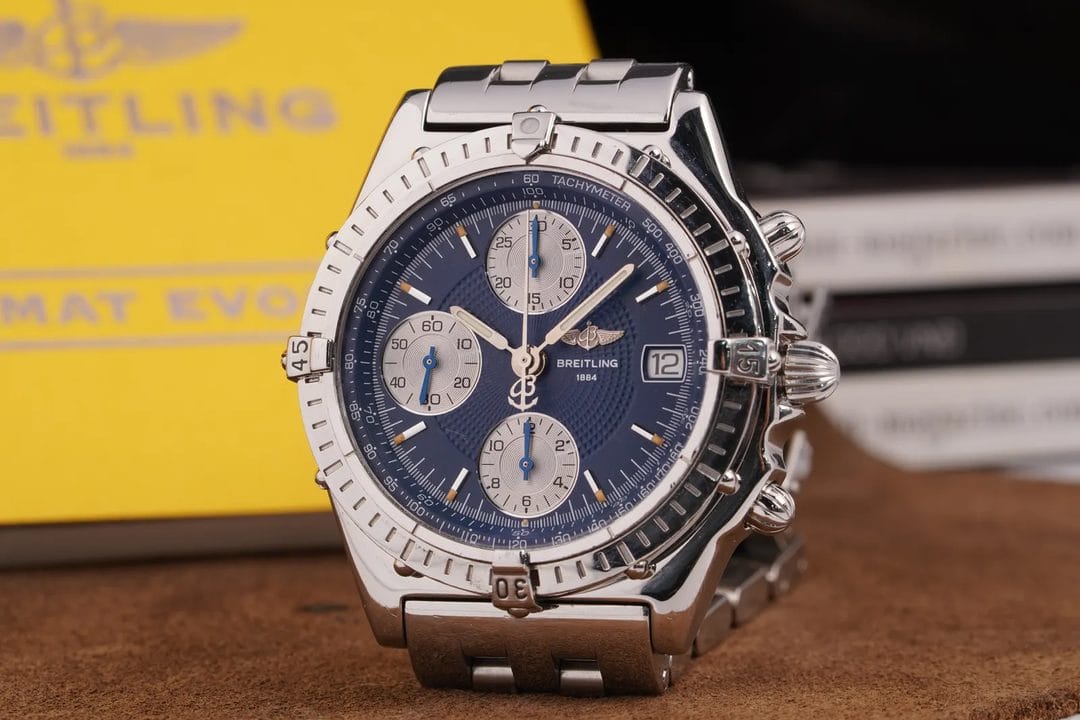
Ask a serious collector about Breitling five years ago and you'd usually get a shrug — a brand associated with oversized steel cases, questionable dial text, and a marketing budget that outspent its horological credibility. Walk into a boutique in 2026, though, and the conversation has changed. The Chronomat B01 42 now sells through at retail in most European boutiques within weeks of restock, something that simply didn't happen in 2019, and waiting lists that used to exist only for Rolex and Patek are quietly forming for specific Breitling references too. Breitling has spent the better part of a decade quietly fixing the things collectors actually complained about — case proportions, movement provenance, dial clutter — rather than chasing the next marketing campaign, and the results are starting to show up in both waiting lists and resale prices. Georges Kern, who took over as CEO in 2017 after a long run reviving IWC, brought the same playbook here: fewer references, better movements, and a deliberate retreat from the brand's mid-2000s habit of putting three chronograph complications on a dial that didn't need any of them. It's the kind of turnaround that takes a decade to show results and one bad collection to undo, which is precisely why the next eighteen months matter more than the last five years already have.
The Navitimer Problem Breitling Finally Solved
For years the Navitimer was Breitling's most recognisable watch and its least wearable one. The 46mm case with a slide-rule bezel and a dial crowded with five sub-registers looked spectacular in a catalogue and awkward on anything but the largest wrist. Georges Kern's team addressed this directly with the 2018 relaunch, and the 2025-2026 collection has pushed the correction further: the Navitimer B01 Chronograph 41 is genuinely proportioned for a 6.5-to-7.5-inch wrist, the slide-rule scale is legible without a loupe, and the case thickness dropped enough that it sits under a cuff without a fight. A steel B01 41 lists around £8,450 / $9,600 retail as of mid-2026, and pre-owned examples in excellent condition trade roughly 15-20% under that on Chrono24 — a gap that has been narrowing since late 2025 as demand for the smaller case caught up with supply.
What still divides opinion is the dial text. Breitling kept "Chronometre" and the certification wording prominent on the dial, which some buyers find honest and others find cluttered next to a Rolex or Omega dial that says almost nothing. There's no fixing that with a spec sheet — you either like the busy dial or you don't, and no amount of movement finishing changes the first impression.
Chronomat B01 42: the watch that actually moves inventory
If one reference explains Breitling's 2026 turnaround, it's the Chronomat B01 42.
The "Rouleaux" bracelet — those distinctive rounded, articulated links — gives the watch a tactile quality that photographs never capture properly, and it's the single biggest reason people who try one on end up buying it rather than a Royal Oak Offshore or a Panerai. Buy the steel B01 42 on bracelet: at roughly £8,150 / $9,300 retail, it undercuts the equivalent AP or Vacheron steel sports watch by a wide margin while running the same in-house B01 chronograph movement Breitling puts in the Navitimer and the Premier. The B01 calibre deserves more credit than it typically gets — it's a column-wheel, vertical-clutch chronograph with a 70-hour power reserve, COSC-certified as standard across the collection, not an upgrade, not a limited variant. Every single B01-equipped Breitling ships chronometer-certified. Compare that to brands charging a premium for COSC as an add-on, and the value case for the B01 42 gets considerably stronger the longer you look at it.
Where the bracelet options matter
- Rouleaux steel bracelet — the reference most collectors actually want, and the hardest to find in stock at UK boutiques
- Rubber strap — roughly £600 cheaper and genuinely underrated for a watch that many owners wear more casually than the dressy bracelet suggests
- Two-tone with 18k red gold — sells slower in Europe, though it's a strong seller in the Gulf and Southeast Asian markets, which tells you something about how regional taste still shapes which references sit on shelves versus which ones don't
Superocean and the dive-watch crowd Breitling never fully won
This is where the brand's progress stalls a little. The Superocean is a genuinely capable tool watch — 300m water resistance across the line, a proper unidirectional bezel, and the same B01 movement in the Superocean Chronograph — but it still hasn't cracked the mental shortlist that automatically includes a Submariner, a Black Bay, and a Seamaster Diver 300M. Part of that is brand association: Breitling built its identity on aviation, and a dive watch from an aviation house has to work harder to earn trust from divers who've spent decades hearing "Rolex, Omega, Tudor" as the default answer.
Buy the Superocean Automatic 42 if you want a genuinely excellent daily tool watch and don't care about resale parity with a Black Bay — at around £3,800 retail it undercuts the Tudor by a meaningful margin and matches it on water resistance and lume quality. Skip it if resale value matters to you more than the watch itself, because right now Superocean examples sit longer on the pre-owned market and trade at steeper discounts to retail than the Chronomat does.
The movement question: B01 versus the ETA years
Breitling's credibility problem in the 2000s and early 2010s wasn't really about design — it was about movements. A brand charging luxury prices while relying heavily on modified ETA calibres invited exactly the criticism it got. The B01, introduced in 2009 and now standard across the Chronomat, Navitimer, and Premier ranges, changed that calculus entirely. It's manufactured in-house at Breitling's La Chaux-de-Fonds facility, uses a column wheel rather than a cam-actuated chronograph mechanism — smoother pusher feel, and the mechanism collectors expect at this price point — and every example leaves the factory COSC-certified.
The B20, Breitling's in-house automatic based on a Tudor MT5602 co-development and adapted with a silicon balance spring, now powers the non-chronograph Superocean and several Premier references, running a 70-hour reserve as well. Between the B01 and B20, Breitling has quietly built the kind of vertically integrated movement portfolio that took Omega and Tudor over a decade to establish, and it happened almost without the watch press making a fuss about it, which is unusual for an industry that treats every new calibre announcement like a product launch event.
What the secondary market actually says
Grey market and pre-owned pricing is the honest scorecard here, more honest than any brand's own marketing. Chronomat B01 42 references have held or slightly appreciated against retail since early 2025, a pattern that used to be exclusive to Rolex and Patek sports models. Navitimer B01 41 examples trade close to retail once you account for VAT differences between the UK and continental Europe. Superocean pricing tells a different story: pre-owned examples routinely trade 20-25% under retail, reflecting weaker demand rather than any flaw in the watch itself. None of this makes Breitling an investment play, and nobody serious should buy any of these watches expecting a return. But the fact that a Chronomat now holds value the way a well-regarded Omega does — rather than depreciating the way a Breitling from 2015 reliably did — is the clearest signal that the brand's decade-long rebuild has actually worked, not just in boutique press releases but in the market where collectors vote with their own money. Dealers on Chrono24 and in London's Hatton Garden both report the same pattern independently, which is usually a more reliable indicator than either one alone.
Who should actually buy one
The Chronomat B01 42 on the Rouleaux bracelet is the easiest recommendation in the current lineup — it's distinctive enough to avoid the "is that a Rolex?" question that dogs so many steel sports watches, it's genuinely well made, and the price gap to an AP or Vacheron equivalent is too large to ignore for most buyers. The Navitimer B01 41 makes sense for anyone who wants aviation heritage without the old model's bulk, though try one on before buying — the busy dial is not for everyone, and a photo simply won't tell you how you'll feel about it after six months of daily wear.
Where does Breitling still lose collectors? At the very top of the conversation, where Rolex, Patek, and AP dominate by reputation alone, and no amount of movement finishing or COSC certification changes that hierarchy overnight. But for buyers shopping the £3,500-£10,000 range who want an in-house chronograph, genuine wrist presence, and a brand that's clearly earned its current momentum rather than bought it with marketing spend, Breitling in 2026 deserves a longer look than it would have got even three years ago.