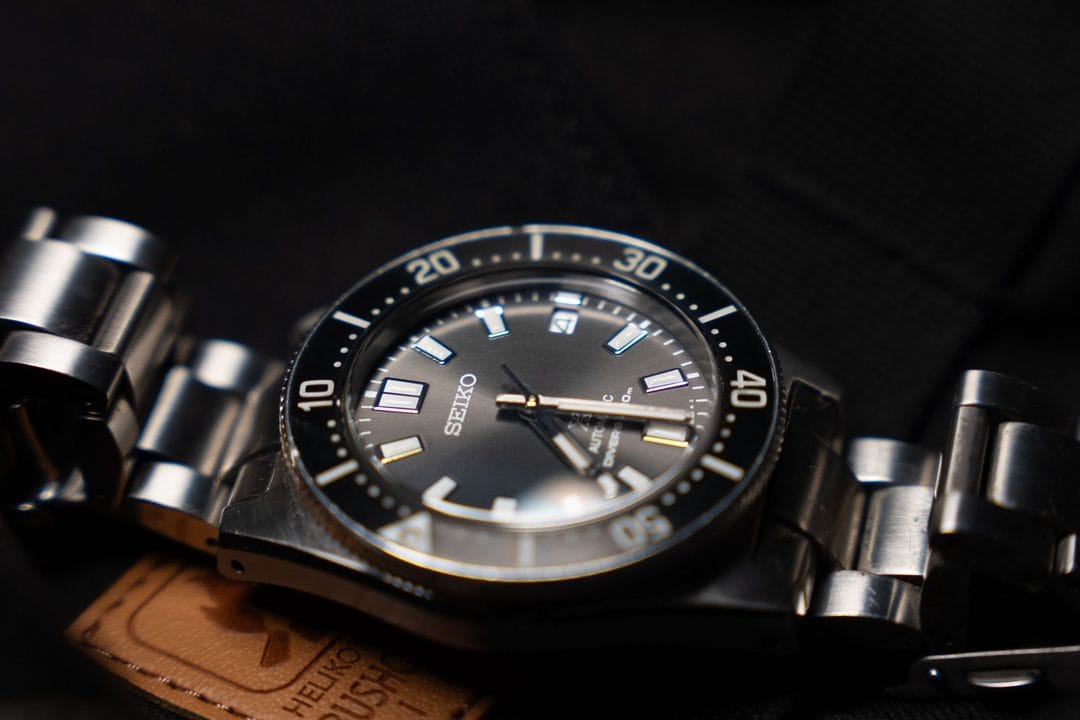
On August 20, Blancpain announced a dive watch that measures 37.4mm across — smaller than a Casio G-Shock, smaller than most men's dress watches sold today, and roughly two-thirds the diameter of the brand's own current flagship diver. It is called the Fifty Fathoms Bathyscaphe 70th Anniversary, reference 5903-1110-63A, and it costs $18,300. Three hundred pieces exist. Most of them were spoken for within the first two weeks, according to dealers tracking the launch. The announcement landed just as Geneva Watch Days opened its seventh edition, a five-day event running through this week with 71 houses spread across five districts of the city. Blancpain isn't among the exhibitors this year, but the trade press that usually spends the opening days of September chasing new steel sports watches has spent a fair share of it instead arguing about a reissue that's smaller than the original everyone had assumed was obsolete.
That argument matters more than the watch itself. For a decade, the dive-watch conversation has run in one direction: bigger cases, thicker bezels, more water resistance than any human will ever need at 300 metres of actual depth. Blancpain just spent real tooling money to go the other way, and collectors answered by buying it out before most of them had tried one on.
What Blancpain actually built
The 70th Anniversary edition reproduces a 1968 Bathyscaphe almost stroke for stroke — 37.4mm wide, 12.3mm thick, 46.5mm lug-to-lug, in polished steel with a black ceramic bezel insert and lacquered numerals. The dial is a sunburst "meteor grey" with baton indexes in 18K white gold and Super-LumiNova tinted to look decades old rather than freshly applied. It ships on a chocolate calf strap with a steel pin buckle, in a Peli hard case, with a five-year warranty attached.
Inside sits the Caliber 1150, Blancpain's own automatic movement rather than a shared Swatch Group base — 28 jewels, a silicon hairspring, and a genuinely useful 100-hour power reserve, all visible through a sapphire display back with an open-worked 18K gold rotor. Water resistance holds at 300 metres, which is more than any diver working with saturation equipment needs and roughly what you'd expect a watch wearing this name to carry regardless of case size. None of that is groundbreaking on paper — 100-hour reserves and silicon hairsprings are close to standard fare at this price point now. What makes the watch interesting is the decision to put a serious in-house movement into a case this small, at a moment when most manufacturers still assume "serious" means 42mm and up.
The history Blancpain is trading on
Small print first.
Blancpain likes to call itself the oldest watch brand in the world, tracing its name back to a 1735 registration by Jehan-Jacques Blancpain in the Swiss village of Villeret. A handful of watch historians, most notably the researcher behind the Perezcope archive, have pointed out that the original 1735 document has never actually been produced and argue the "oldest brand" story was largely constructed during the modern era rather than inherited whole from the 18th century. Whatever the truth of the founding date, the part of the history that isn't in dispute is more useful here: the Fifty Fathoms itself, launched in 1953, is widely credited as the first modern dive watch — the piece that introduced a rotating, unidirectional bezel with a diving scale as a factory-standard feature rather than an aftermarket fix. It came out of two parallel efforts in the early 1950s, one from Blancpain's own CEO, Jean-Jacques Fiechter, an avid diver himself, and another from French combat-diving officers Bob Maloubier and Claude Riffaud, who needed a purpose-built instrument for underwater demolition work and went looking for a manufacturer willing to build it to their specification. Blancpain said yes, and the watch that resulted became standard issue for naval units well beyond France, including divisions in Germany, Norway, Israel, and eventually the U.S. Navy SEALs.
Jacques Cousteau wore one on his wrist through "Le Monde du Silence" in 1956, the documentary that introduced most of the world to underwater filmmaking, and that single piece of screen time did more for the Fifty Fathoms' reputation than any advertising budget could have managed. Not every watch historian accepts the "first" claim without an asterisk, though — Rolex was developing the Submariner on a nearly identical timeline, and some researchers argue Cousteau had access to an early Submariner before Blancpain's watch ever reached him. Whichever bezel actually crossed the finish line first, the Fifty Fathoms is the design that French, and later NATO, divers actually carried into the water for the next thirty years, and that's the lineage the Bathyscaphe 70th Anniversary is selling. It's also, separately, a brand that famously refused to make a single quartz watch through the 1970s and '80s crisis that gutted the rest of Swiss watchmaking — a stance that became central to its marketing once Jean-Claude Biver took the brand over in 1983 and rebuilt it almost entirely around mechanical purism.
Why 37.4mm is the actual story
Blancpain's current Fifty Fathoms lineup runs large. The standard three-hand Bathyscaphe sits at 43mm and retails around $9,425; step up to the full-size Fifty Fathoms and you're at 45mm and roughly $20,800 to $23,800 depending on dial and bracelet configuration. Against that backdrop, a 37.4mm reissue reads less like a nostalgia exercise and more like a market test — Blancpain wanting to know whether buyers who've spent years complaining about oversized dive watches online will actually put money behind a genuinely small one.
Early sales say yes, and the timing isn't a coincidence. Tudor's Black Bay 58 built an entire sub-category around the idea that 39mm is plenty for a dive watch, and it's sold well enough — around $4,075 for the current Navy Blue reference — that every brand with dive-watch heritage has been quietly measuring the gap it opened up. Omega hasn't shrunk the Seamaster Diver 300M below 42mm. Rolex hasn't touched the Submariner's 41mm case since the 2020 update. Blancpain, instead of nudging its existing Bathyscaphe down a millimetre or two the way a smaller brand might, went all the way back to a 1968 reference and rebuilt it faithfully — a bigger bet, and a clearer signal about where the brand thinks the next five years of demand actually sits.
What this means if you're actually buying
Buy the 70th Anniversary if you can still find one through an authorised dealer at retail. A 300-piece run from a brand with Blancpain's collector base rarely stays flat, and comparable Fifty Fathoms limited editions have traded 15 to 25 percent over retail within a year of release on the secondary market. Don't chase it at a premium the week it sells out, though — wait three to six months and let the initial flipping wave settle, because early aftermarket pricing on any hyped limited edition gets set by the most impatient buyers in the room, not the most rational ones, and that gap tends to close once the novelty wears off.
If the waitlist doesn't work out, the standard 43mm Bathyscaphe at roughly $9,425 gets you the same Caliber 1150 architecture and the same 300m rating in a production run with no artificial scarcity attached — a genuinely better watch for anyone who actually wants to wear a Blancpain daily rather than own a numbered piece to look at. And if the appeal was really about the small proportions rather than the Blancpain name specifically, the Tudor Black Bay 58 does the 39mm dive-watch job at less than a quarter of the price, with a five-year warranty and a service network that's considerably easier to use outside major cities.
What the Bathyscaphe 70th Anniversary actually proves is narrower than the launch coverage suggests. It doesn't prove that big dive watches are finished — Rolex will sell every Submariner it makes this year regardless of what Blancpain does with a 300-piece run. It proves that a manufacturer with real archive credibility, disputed founding date and all, can put a genuinely small watch back on shelves and watch serious money show up within days, which is more than most predictions about "the return of small watches" have managed to back up with an actual sales result.